instagram.com/SpecialKidsEducation

Parenting a child with ADHD is exhausting. You give the same instruction five times. You watch them struggle to start homework. You brace yourself for the meltdown when you ask them to turn off the tablet. It’s easy to fall into a pattern of nagging, yelling, and punishing—and then feeling guilty afterward. But here’s the truth: traditional discipline doesn’t work well for the ADHD brain. Punishment doesn’t teach skills. What works is a different approach—one built on connection, structure, and positive reinforcement. This guide offers positive parenting strategies specifically designed for children with ADHD. These aren’t permissive or easy. They’re intentional, evidence-based, and they work. You’ll learn how to reduce meltdowns, build cooperation, and create a home environment where both you and your child can thrive.
Why Traditional Discipline Fails the ADHD Brain
To understand why positive parenting strategies are so effective for ADHD, you first need to understand why traditional discipline often backfires. Consequences that are delayed (like losing screen time at the end of the day) don’t connect to the behavior in the ADHD brain. Punishment increases emotional dysregulation, making it harder for the child to think clearly. And shame—which often accompanies traditional discipline—damages the parent-child relationship without improving behavior. Children with ADHD already receive far more negative feedback than their peers. Adding more doesn’t help. What helps is teaching skills in the context of connection. This approach to supportive parenting aligns with the broader strategies discussed in our pillar resource, Understanding ADHD in Children: Signs, Challenges, and Support Strategies.
Strategy 1: Build Connection Before Correction
Before you can effectively address behavior, your child needs to feel seen, heard, and connected to you. When connection is strong, cooperation follows more naturally.
- Special time: Spend 10-15 minutes each day doing something your child chooses—no phones, no directions, no corrections. Just you, your child, and their chosen activity. This fills their emotional cup.
- Notice the good: Catch your child being good. “I saw how patiently you waited for your turn. That was kind.” “Thank you for putting your plate in the sink without being asked.” Aim for a 5:1 ratio of positive to negative interactions.
- Use calm connection moments: When you see your child starting to escalate, move closer. Use a softer voice. A gentle hand on the shoulder. Connection calms the nervous system.
Strategy 2: Set Clear, Consistent Expectations
The ADHD brain craves predictability. When expectations are clear and consistent, there’s less to figure out—and less resistance.
- Post family rules: Keep them simple, positive, and visible. “We use kind words. We take turns. We clean up after ourselves.”
- Use “when/then” statements: “When your homework is finished, then you can have screen time.” This is clearer than “No screen time until your work is done.”
- Be consistent across caregivers: If rules and consequences differ between parents, or between home and school, the ADHD brain struggles to keep up. Get on the same page.
Strategy 3: Use Positive Reinforcement, Not Punishment
Positive reinforcement is one of the most powerful positive parenting strategies for ADHD. It works with the brain’s dopamine system, building motivation from the inside out.
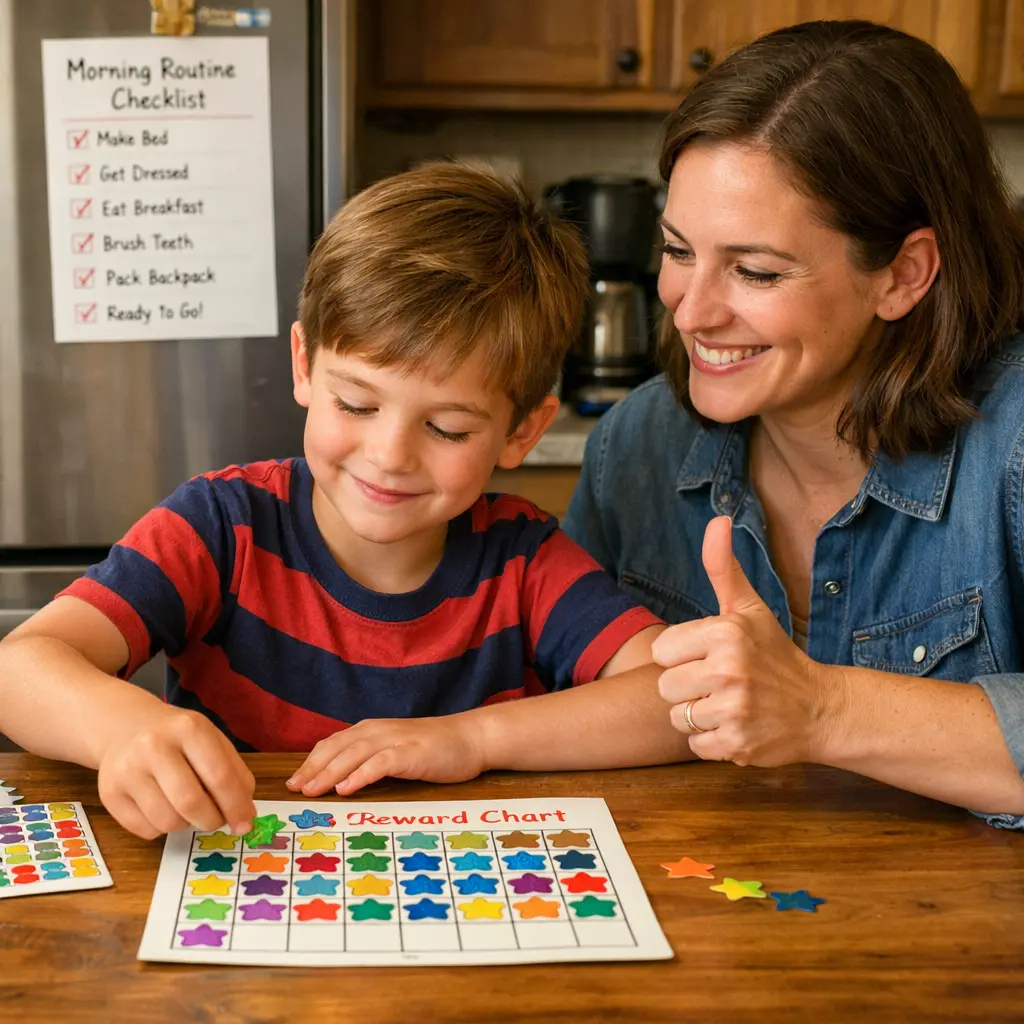
- Create a token system: Use stickers, points, or tokens for specific desired behaviors. “You earn a token every time you start your homework without a reminder.” Tokens can be exchanged for small, immediate rewards (extra screen time, a special snack, a trip to the park).
- Make rewards immediate: The ADHD brain doesn’t connect well to delayed rewards. A reward at the end of the week is too far away. Use daily or even same-day rewards.
- Catch them trying, not just succeeding: “I saw you take a deep breath when you got frustrated. That’s a great skill.” Effort matters as much as outcome.
Strategy 4: Reduce Meltdowns by Managing Triggers
Meltdowns aren’t manipulative—they’re the result of an overwhelmed nervous system. Prevention is more effective than intervention.
Understanding your child’s unique triggers often starts with recognizing the early signs of ADHD and how they manifest in daily life.
- Identify common triggers: Transitions? Hunger? Fatigue? Overstimulation? Keep a simple log for a week. Notice patterns.
- Plan for known triggers: If transitions are hard, use warnings and timers. If hunger is a trigger, keep healthy snacks available. If overstimulation is a trigger, build in quiet breaks.
- Lower demands during tough times: Before dinner when everyone is tired is not the time to insist on a clean room. Adjust expectations based on your child’s capacity at that moment.
Strategy 5: Give Effective Instructions That Get Followed
How you give instructions dramatically affects whether they’re followed. These techniques work with the ADHD brain, not against it.
- Get their attention first: Say your child’s name. Wait for eye contact or a verbal acknowledgment. Don’t give instructions from across the room.
- Keep instructions short and specific: “Please put your shoes in the closet” instead of “Go clean up your stuff.”
- Use “first/then”: “First finish your math worksheet, then you can play outside.” This provides a clear sequence.
- Ask them to repeat back: “What did I just ask you to do?” This ensures the instruction was heard and processed.
Strategy 6: Use Natural and Logical Consequences (Calmly)
Consequences aren’t off the table—they just need to be delivered calmly and connected to the behavior.
- Natural consequences: “If you don’t put your shoes in the basket, you won’t be able to find them in the morning.” Then let it happen (within safe limits).
- Logical consequences: “If you throw your toy, the toy goes away for the rest of the day.” The consequence is directly related to the behavior.
- Deliver consequences calmly: “You threw the toy after we talked about it. The toy is going away now. You can try again tomorrow.” No lectures, no shaming.
Strategy 7: Create Routines That Automate Cooperation
When behaviors are automated through routines, you don’t have to nag. The routine does the work.
- Morning routine: Use a visual checklist (with pictures for younger kids). “Wake up, brush teeth, get dressed, eat breakfast, pack backpack, shoes on.”
- After-school routine: Unpack backpack, have a snack, do homework, free time, chores, dinner.
- Bedtime routine: Bath, pajamas, brush teeth, read together, lights out. Consistency signals the brain that sleep is coming.
- Practice the routine: When things are calm, walk through the routine together. Make it a game. “Let’s see how fast we can do the morning routine!”
Strategy 8: Teach Emotional Regulation Skills
Meltdowns often happen because your child lacks the skills to manage big feelings. These skills can be taught.
- Build an emotional vocabulary: “You look frustrated. Frustrated means you want to do something but it’s hard. Is that how you feel?”
- Create a calm-down toolkit: A box with fidget toys, a small weighted lap pad, headphones, a glitter jar, and a list of favorite coping strategies (jumping jacks, drawing, deep breaths).
- Use the “Zones of Regulation”: Blue (tired/sad), Green (calm/ready), Yellow (wound up/frustrated), Red (out of control). Help your child identify their zone and choose tools to get back to green.
- Model your own regulation: “I’m feeling really frustrated right now. I’m going to take three deep breaths.” Children learn regulation by watching us.
Strategy 9: Pick Your Battles and Let Go of Perfection
Not every behavior needs a consequence. Some things can be ignored. Some expectations can be lowered. Choose what matters most.
- Focus on safety, respect, and responsibility: Those are the non-negotiables. A messy room? Maybe not the hill to die on. Pajamas that don’t match? Who cares?
- Ask yourself: “Will this matter in five years?” Most things won’t. Let them go.
- Lower the bar on good days so you have energy for hard days: Don’t use up all your parenting energy enforcing a “clean plate” rule if a bigger battle is coming later.
Strategy 10: Take Care of Yourself (This Is Not Selfish)
Parenting a child with ADHD is hard. You can’t pour from an empty cup. Self-care isn’t indulgent—it’s essential.
- Build in breaks: Even 10 minutes of quiet can reset your nervous system. Tag-team with a partner or ask a friend for help.
- Find your people: Connect with other parents of children with ADHD. They understand. They won’t judge. They have tips.
- Let go of guilt: You will lose your patience. You will say things you regret. You will try strategies that fail. This doesn’t make you a bad parent. It makes you human. Repair, apologize, and try again.
Putting It All Together: A Sample Daily Routine
Here’s how these positive parenting strategies might look in a real day:
- Morning: Visual checklist on the fridge. Child earns a token for each completed step. After 5 tokens, they get 15 minutes of tablet time before school.
- After school: Snack and 20 minutes of free time to decompress. Then “first homework, then screen time.” Parent sits nearby (body doubling) during homework.
- Dinner: Child helps set the table (a chore with a token reward). Family meal with no devices. Positive conversation about the day.
- Evening: 15 minutes of special time—child chooses the activity. Then bedtime routine with visual checklist. Child earns a final token for completing the routine without resistance.
- Throughout the day: Parent catches child being good and offers specific praise. When a meltdown starts, parent moves closer, lowers voice, and offers a calm-down tool. Consequences are delivered calmly and connected to the behavior.
Frequently Asked Questions (SSS)
Q: What do I do when my child is in the middle of a meltdown?
A: In the moment, don’t teach, don’t lecture, don’t punish. Focus on safety. Stay calm (or fake it). Reduce demands. Offer a calm-down tool if they can accept it. Sometimes the best thing is to sit nearby quietly and wait. After they’re regulated, then you can talk about what happened and practice skills for next time.
Q: What if positive reinforcement doesn’t work for my child?
A: If it’s not working, check the reward. Is it motivating enough? Is it immediate enough? Is the expectation clear? Sometimes the token system needs tweaking. Also, some children are motivated by connection or privileges rather than tangible rewards. Ask your child: “What would help you want to get ready in the morning?”
Q: How do I handle public meltdowns without losing my cool?
A> Public meltdowns are every parent’s nightmare. First, know that most people are more understanding than you think—or they’re not paying attention. Second, have a plan. A quick exit strategy. A calm-down kit in your bag. A script: “We’re having a hard moment. I need to step outside with my child.” Prioritize your child’s regulation over strangers’ opinions.
Q: My partner and I disagree on discipline. What do we do?
A: This is very common and very stressful. The ADHD brain needs consistency. If possible, attend a parent training program together (like PCIT or Incredible Years). Read the same book. Agree to try a new approach for a set period (say, 4 weeks), then evaluate together. If you can’t agree, at minimum, present a united front to your child—no undermining each other in front of them.
Q: I’ve tried all of this and nothing works. What now?
A: First, breathe. You’re not failing. Some children need professional support. Consider parent training (behavioral parent training is evidence-based for ADHD). Consider family therapy. Consider an evaluation for co-occurring conditions (anxiety, ODD, learning disabilities). And remember: progress is slow. Pick one strategy from this guide and try it for two weeks. Just one. See what happens. Then add another.
Conclusion: You Are the Anchor, Not the Storm
Parenting a child with ADHD is not for the faint of heart. There are days when you will feel like all you do is nag, redirect, and break up fights. There are days when you will lose your patience and wonder if you’re making things worse. But here’s what I want you to remember: you are not failing. Your child’s brain is wired differently, and the strategies that work for other children don’t work for yours. That’s not your fault—or theirs. The positive parenting strategies in this guide—connection before correction, clear routines, positive reinforcement, calm consequences—are not about being a perfect parent. They’re about being an intentional one. They’re about understanding how your child’s brain works and meeting them there. You will mess up. You will yell sometimes. You will try strategies that flop. That’s okay. What matters is that you keep showing up, keep repairing, and keep believing in your child. You are their anchor in a stormy sea of big feelings and impulsive actions. And with the right tools—and a whole lot of grace—you can help them learn to navigate those waters themselves.