instagram.com/SpecialKidsEducation



If your child has persistent, challenging behaviors at school — outbursts, defiance, aggression, or severe disruption — you may have heard the term Behavior Intervention Plan (BIP). But what exactly is a behavior intervention plan for child? And how do you get one? A BIP is a formal, written plan that uses positive strategies to teach and reinforce desired behaviors while reducing problematic ones. It is not a punishment plan. It is a teaching plan. A well-written behavior intervention plan for child can transform school from a place of constant conflict to one of success. This step-by-step guide will walk you through what a BIP is, how it fits into the IEP process, how to request one, what to look for in a quality plan, and how to ensure it is implemented effectively. Whether your child has an IEP or a 504 Plan, understanding BIPs will make you a powerful advocate.
What Is a Behavior Intervention Plan (BIP)? A Teaching Tool, Not a Punishment System
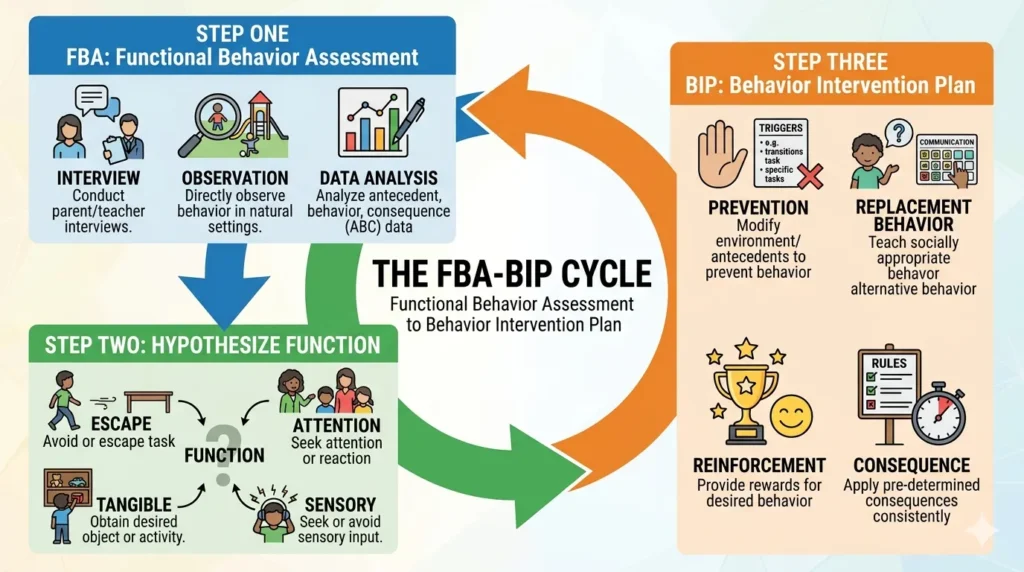
A behavior intervention plan for child (BIP) is a proactive, evidence-based document designed to address challenging behaviors by teaching replacement behaviors and modifying the environment. It is always based on a Functional Behavior Assessment (FBA), which identifies the why behind the behavior. The BIP specifies:
- Target behaviors: The specific behaviors to be addressed (e.g., “hitting peers when transitioning between activities”).
- Function of behavior: What the child is trying to achieve (e.g., “escape from difficult tasks,” “get attention from peers”).
- Prevention strategies: Environmental changes to reduce triggers (e.g., “preview transitions with a timer and visual schedule”).
- Replacement behaviors: What the child should do instead of the problem behavior (e.g., “ask for a break using a break card”).
- Reinforcement strategies: How to reward the replacement behavior (e.g., “earn a token for using a break card”).
- Consequences: How to respond when the problem behavior occurs (with a focus on neutral, non-punitive responses).
- Data collection: How the team will track progress.
Understanding the BIP and FBA process is central to effective advocacy for children with Emotional and Behavioral Disorders. This builds on the strategies discussed in our pillar resource, Emotional and Behavioral Disorders in Children: 7 Early Warning Signs Every Parent Must Know.
How a BIP Fits into the IEP or 504 Plan
Not every child who needs behavior support has a BIP. However, for children with significant externalizing behaviors in children or internalizing behaviors that impact learning, a BIP can be a vital part of an Individualized Education Program (IEP) or a 504 Plan.
- IEP and BIP: Under IDEA, students with disabilities whose behavior impedes their learning or the learning of others must have positive behavioral supports considered. If the IEP team determines that a BIP is necessary, it becomes part of the IEP. The BIP does not replace the IEP — it is included within it or attached.
- 504 Plan and BIP: A BIP can also be part of a 504 Plan, though it is less common. For students whose emotional or behavioral challenges substantially limit a major life activity (like learning) but who do not need specialized instruction, a 504 Plan with a BIP may be appropriate.
If your child does not yet have an IEP but needs a BIP, you can request a special education evaluation to determine eligibility under categories such as Emotional Disturbance (ED), Other Health Impairment (OHI for ADHD), or a specific learning disability.
Requesting a BIP: A Step-by-Step Guide for Parents
If your child is struggling with persistent, severe behaviors at school, here is how to request a behavior intervention plan for child.
- Put your request in writing. Write a brief, factual letter or email to the school principal and special education director/director of student services. Include your child’s name, grade, and specific concerns (“My child has daily outbursts, hits other students, and is sent to the office several times a week.”). State clearly: “I am requesting a Functional Behavior Assessment (FBA) and a Behavior Intervention Plan (BIP) for my child.”
- Keep a paper trail. Date your letter and email. Keep copies of all correspondence. Track follow-up conversations.
- Know your timeline. Once you make the request, the school has a legal obligation to respond. If your child already has an IEP, the IEP team should meet to consider an FBA/BIP within a reasonable time (often 30-45 days).
- Ask for an IEP team meeting. If necessary, call a meeting to discuss your request. Come prepared with specific examples of behavior, its frequency, and its impact on your child’s learning and peer relationships.
- If the school refuses, ask for a Prior Written Notice (PWN). The school must provide a written explanation of why they are refusing and what data they are using to support their decision. This can be the basis for further advocacy (e.g., requesting mediation).
The Functional Behavior Assessment (FBA): The Why Behind the Behavior
A strong behavior intervention plan for child is built on a solid FBA. The FBA is a process for identifying the function (purpose) of a child’s behavior. All behavior serves a function. Common functions include:
- Escape/Avoidance: The child behaves in a certain way to avoid a difficult task, a non-preferred activity, or an overwhelming situation. (Example: A child who screams when asked to do math worksheets may be trying to escape the work.)
- Attention-Seeking: The child behaves to get attention from adults or peers (even negative attention is attention). (Example: A child who calls out constantly may be seeking teacher attention.)
- Access to Tangibles: The child behaves to get a preferred item, activity, or sensory input. (Example: A child who grabs others’ toys may want the toy.)
- Sensory/Automatic Reinforcement: The child behaves because the behavior itself feels good or provides internal relief. (Example: A child who rocks or spins for self-stimulation.)
The FBA process involves collecting data through teacher and parent interviews, direct observation, and sometimes behavior rating scales. The outcome is a clear statement of the hypothesized function of the behavior. If the school proposes a BIP without an FBA, be cautious. A BIP based on assumptions, not data, is unlikely to be effective.
What Makes a Good BIP? Key Components to Look For
When you review a proposed behavior intervention plan for child, look for these essential components. If any are missing, ask questions.
- Clear, measurable target behaviors: Not “aggression” but “hitting peers during transitions, defined as making physical contact with an open or closed fist, occurring 4-5 times per day.”
- Hypothesized function based on FBA: “Behavior serves to escape difficult tasks.”
- Prevention strategies: What will adults do to prevent the behavior? “Reduce task length, provide a choice of assignments, use a timer to show how long work will last.”
- Explicit replacement behaviors: What should the child do instead? “Teach and prompt the student to request a break using a ‘break card’ or to raise a hand for help.”
- Reinforcement plan for replacement behaviors: “Each time the student requests a break appropriately, he earns a token. After 3 tokens, he earns 5 minutes of computer time.”
- Consequences for problem behavior (non-punitive): “If hitting occurs, the teacher will neutrally redirect, ‘You need to take a break,’ and the student will go to the cool-down corner for up to 5 minutes. The student will not be allowed to escape the original task; the task will be waiting after the break.”
- Crisis plan (if needed): For dangerous behavior (severe aggression, property destruction, elopement), the BIP must include a crisis plan: how to ensure safety, who will respond, and how to de-escalate.
- Data collection: How will the team track progress? “Daily frequency count of hitting. Weekly review by IEP team.”
- Plan for fading supports: As the student improves, how will prompts and reinforcement be reduced? This ensures the child doesn’t become dependent on external rewards.
What to Do If the School Refuses to Do an FBA or BIP
Sometimes schools resist. Here is how to respond.
- Ask for their data: “I understand you don’t think a BIP is necessary. Can you share the data you have on my child’s behavior? How often it occurs? How it impacts learning?”
- Document the impact on learning: “My child has been sent to the office 12 times this month. He is missing hours of instruction. His grades are dropping. This is impacting his educational performance.”
- Request a Prior Written Notice (PWN): If the school still refuses, request a PWN explaining their decision in writing. This document can be evidence if you need to escalate.
- Seek help from a parent advocate or educational attorney: Sometimes a letter from an advocate can change the school’s position.
- Consider mediation or a due process complaint: If behavior is severely impacting your child and the school refuses to act, you have legal options.
How to Monitor BIP Implementation and Progress
Once a behavior intervention plan for child is in place, your job is not done. Monitor its implementation.
- Ask for data at regular intervals: “Can you share the frequency count of hitting for the last two weeks?”
- Check if strategies are being used consistently: “Is the break card available at all times? Are staff prompting its use?”
- Observe the classroom (you have the right): Request to observe your child’s classroom to see if the BIP is being implemented with fidelity.
- Communicate with the teacher and school psychologist: Regular check-ins (weekly email, brief phone call) can catch problems early.
- Request a BIP review meeting if progress is stalled: If the data shows no improvement after 6-8 weeks, the BIP may need revision. Ask the team to reconvene.
Implementing BIP Strategies at Home: Consistency Across Environments
Children with challenging behaviors benefit enormously when similar strategies are used at home and school. While you cannot replicate the school BIP exactly, you can adopt core principles.
- Identify the function of behavior at home: What is your child trying to get or avoid? Escape from chores? Attention from you? Access to screens?
- Use similar language: “At school, you use a break card when you feel overwhelmed. Let’s try that at home too. Here is your home break card. You can use it to take 5 minutes in your calm-down corner.”
- Reinforce the same replacement behaviors: If requesting a break is the goal at school, praise and reward it at home too.
- Stay in communication with the school team: Ask what is working at school. Share what is working at home. Consistency makes learning faster.
Frequently Asked Questions (SSS)
Q: My child doesn’t have an IEP. Can they still get a BIP?
A: Yes, a BIP can be written for any student, even those without disabilities, as a general education intervention. However, without an IEP, there is less legal protection for implementation. If your child has a disability that impacts learning, requesting an evaluation for special education is often the better path.
Q: How long does it take to get a BIP after I request it?
A: If your child already has an IEP, the team should meet to discuss the request within a reasonable time (often 30-45 days). The FBA process itself may take 4-6 weeks. A BIP is typically written within 30 days of the FBA. Total timeline from request to final BIP: often 8-12 weeks. If your child’s behavior is dangerous, ask for an interim safety plan while the FBA/BIP is being developed.
Q: Can I refuse to consent to a BIP?
A: You can refuse to consent to an initial IEP or BIP. However, if the BIP is part of an IEP that you have already consented to, the school may have the right to implement it without your consent if they have followed proper procedures. It is better to advocate for a strong BIP at the meeting than to refuse consent entirely.
Q: Can the BIP include “time-out” or “detention”?
A: Yes, but with limits. Time-out or detention should be brief, non-punitive, and focused on de-escalation and skill-building. Extended isolation (seclusion) or physical restraint should never be used unless there is a separate crisis plan and training. If your child’s BIP includes significant use of time-out, ask: “How does this time-out teach replacement behavior? What is the plan to fade it?”
Q: What if the BIP isn’t working after several months?
A: Call an IEP team meeting. Request a review of the FBA to ensure the function was identified correctly. Ask for changes to the BIP. If the school has not implemented it with fidelity, address that first. If it has been well-implemented and is still not working, consider bringing in an outside mental health professional to support the team.
Conclusion: A BIP is a Roadmap to Success
A well-written behavior intervention plan for child is not a punitive document. It is a roadmap. It shows your child: “We understand why you are struggling. We are going to change the environment to help you succeed. We will teach you what to do instead. We will reward you for trying. And when you make mistakes, we will respond calmly and teach again.” This is the opposite of punishment. This is teaching. Advocating for a strong BIP is one of the most important things you can do for a child with persistent challenging behaviors. It shifts the focus from “fixing the child” to “fixing the environment.” And that is where real change begins. Do not be intimidated by the process. Use this step-by-step guide to advocate for the support your child needs — and deserves.