instagram.com/SpecialKidsEducation

For a child with hearing loss, language doesn’t just happen—it has to be intentionally nurtured. While hearing aids and cochlear implants provide access to sound, it’s the consistent, loving interactions at home that turn those sounds into meaningful language. Creating a language-rich environment for deaf children is the single most powerful thing you can do to support their speech, literacy, and cognitive development. A true language-rich environment for deaf children doesn’t require special training or expensive materials. You just need awareness, intention, and a few simple strategies. This guide offers seven practical, joy-filled ways to transform your everyday routines—mealtimes, bath time, playtime—into powerful opportunities for language growth. Let’s turn your home into a language-learning sanctuary where your child can thrive.
Why a Language-Rich Environment Matters Most for Deaf Children
Before we dive into the strategies, let’s understand why the home is so critical. A child spends only a fraction of their waking hours in therapy or at school. The majority of their language exposure happens at home, in the context of daily life. For a child with hearing loss, who may miss incidental language—the conversations happening around them, the TV in the background, the sibling chattering in the car—this intentional home focus is not just helpful, it’s essential. Research consistently shows that the quantity and quality of words a child hears at home is the single biggest predictor of future academic success. By committing to a language-rich environment for deaf children, you are building the foundation for everything else: reading, writing, social connection, and confident communication. This philosophy of holistic support is at the heart of our pillar resource, Supporting Children with Hearing Loss: Communication and Inclusion .
The Golden Rules Before You Begin
These three principles apply to every strategy that follows. Keep them in mind always as you build your language-rich environment for deaf children.
Rule 1: Get Face to Face
Never talk to your child from across the room or from behind them. Get down to their eye level. This ensures they can see your face, your lips, and your expressions. It also signals, “What I’m about to say is important, and you matter to me.”
Rule 2: Reduce the Noise
A language-rich environment is not a noisy one. Background noise—the TV, the radio, the dishwasher—is the enemy of clear listening for a child with hearing loss. Before you engage in conversation, make a habit of reducing the auditory clutter. This simple act doubles the clarity of your speech.
Rule 3: Follow Their Lead
The best learning happens when a child is already interested. If your child is fascinated by a truck, talk about the truck. Don’t try to redirect them to a flashcard. Follow their curiosity, and use it as your gateway to language.
Strategy 1: Narrate Your Day (Self-Talk and Parallel Talk)
This is the most powerful and easiest strategy to implement. It costs nothing and requires no prep time, yet it’s the cornerstone of any language-rich environment for deaf children.
- Self-Talk: Describe what you are doing as you do it. “I’m chopping the carrot. Listen to the crunch! Now I’m putting the carrot in the soup. The soup is hot!”
- Parallel Talk: Describe what your child is doing. “You’re stacking the blue block. Up, up, up! Now you’re adding the red block. Oh, it fell! You knocked it down!”
- Why It Works: This constant narration bathes your child in clear, simple, repetitive language directly tied to what they are seeing and doing. It creates a direct connection between words and their meaning, which is the essence of building a language-rich environment.
Strategy 2: Read, Read, and Read Again (with a Twist)
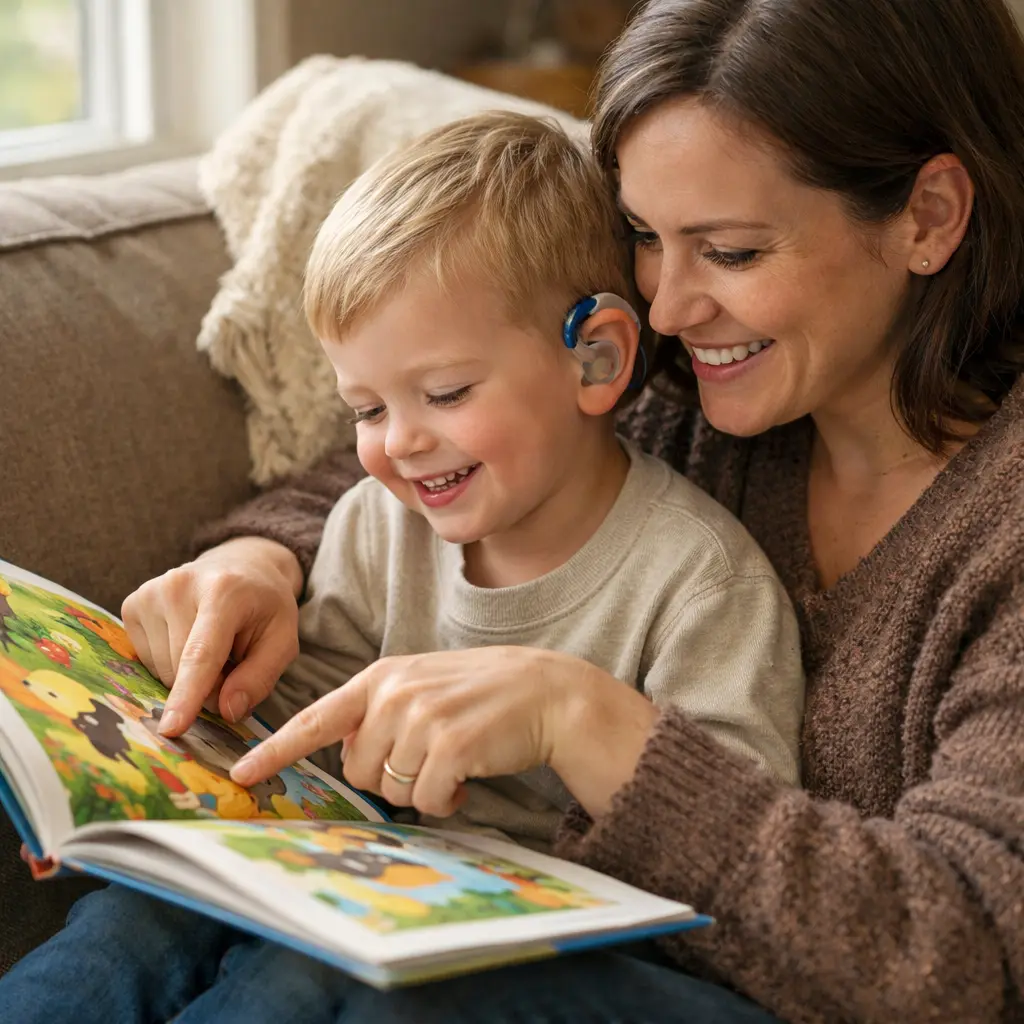
Reading together is a cornerstone of language development, but for a child with hearing loss, a few small adaptations make all the difference in creating a language-rich environment for deaf children.
- Position Matters: Sit facing your child, with the book held so they can see both the pages and your face.
- Make It Interactive: Don’t just read the words. Point to the pictures. Ask simple questions. “Where’s the dog?” “What color is the ball?” Pause and wait for a response—a point, a sound, a word.
- Repeat, Repeat, Repeat: Children learn through repetition. Reading the same book fifty times is not boring; it’s mastery. Each time, they pick up new words and concepts.
- Connect to Real Life: If you read a book about a trip to the grocery store, talk about your own trip to the grocery store. Build those bridges between books and the world.
Strategy 3: Sing with Enthusiasm and Pauses
Songs are language lessons set to music. The rhythm, melody, and repetition make words stick, and they’re a joyful part of any language-rich environment for deaf children.
- Get Animated: Use gestures, facial expressions, and movement. “The wheels on the bus go round and round…” actually spin your arms!
- Use the Power of the Pause: Sing a familiar song, then pause right before a key word. “Old MacDonald had a farm, E-I-E-I-____!” Wait, with an expectant look. Give your child a chance to fill in the blank—with a sound, a word, or even just excited vocalization. Then, sing the word clearly: “O!”
- Make Up Songs: Sing about what you’re doing. “We are putting on our shoes, on our shoes, on our shoes…” to a simple tune.
Strategy 4: Create a “Language-Rich” Physical Environment
Your home’s physical space can be a silent teacher, reinforcing the language-rich environment for deaf children you’re building.
- Label Things: Use sticky notes or cute labels to put words on objects: door, window, fridge, table. Your child will absorb these words through repeated exposure.
- Create Themed Baskets: Have a basket of toys related to a theme—farm animals, vehicles, kitchen items. When you pull out the basket, you pull out a world of related vocabulary.
- Display Their Work: Hang their drawings on the fridge. Talk about them. “Tell me about your picture. Is that a sun? What a beautiful blue sky!”
Strategy 5: Use the “Three-Step Rule” for New Words
When introducing a new word, use this simple three-step process. It’s a technique used by speech therapists and fits perfectly into a language-rich environment for deaf children.
- Say it clearly: “Look! A butterfly!”
- Show it: Point to the butterfly in the garden or in a book.
- Use it in context: “The butterfly is flying. The butterfly has pretty wings. Bye-bye, butterfly!”
Then, look for opportunities to repeat the word throughout the day. Repetition across different contexts is how words move from short-term to long-term memory.
Strategy 6: Limit Screen Time, Maximize Interaction
This is a tough one in the modern world, but it’s crucial for maintaining a true language-rich environment for deaf children. Screens are passive. Language learning is active.
- Watch Together: If they watch a show, watch with them. Talk about what you’re seeing. Pause it and ask questions. “Why is Peppa sad?” Connect it to real life.
- Choose Interactive Apps: If you use screens, choose apps that require a response, not just passive viewing.
- Prioritize Human Connection: The most important “device” in your language-rich environment is you. Your face, your voice, your attention. Nothing can replace that.
Strategy 7: Embrace “Auditory First” Moments
While visual cues are important, also create moments where your child relies on listening alone. This adds another dimension to your language-rich environment for deaf children.
- Play “What’s That Sound?”: Close your eyes and listen. Is that a dog barking? A car horn? The doorbell?
- Give Simple Auditory Directions: “Can you go get your shoes?” without pointing. If they struggle, help them, but keep trying.
- Practice on the Phone: Have Grandma call and say a few simple words. This isolates the auditory signal and builds listening stamina.
Frequently Asked Questions (SSS)
Q: My child gets frustrated when I try to “teach” during play. What should I do?
A: Stop “teaching” and just play. The goal of a language-rich environment for deaf children isn’t to turn every moment into a lesson. Just be present, follow their lead, and narrate naturally. If they feel pressure, they’ll shut down. Trust the process.
Q: How do I balance language input for my child with hearing loss with the needs of my other children?
A: This is a real challenge. Include everyone! Many of these strategies—reading aloud, singing, narrating your day—benefit all children. For more focused time, try to carve out 10-15 minutes of one-on-one time each day where you can really focus on your child.
Q: Should I use sign language along with spoken language?
A: Absolutely. This is called “total communication,” and it’s a wonderful approach. Using signs doesn’t prevent speech; it supports it by giving the child a visual representation of language. It reduces frustration and builds the foundation for symbolic communication.
Q: What if I’m not a “talkative” person? This feels overwhelming.
A: Start small. Pick just one strategy—maybe narrating bath time or reading one extra book at night. You don’t have to become a non-stop chatterbox. Small, consistent efforts are what create a language-rich environment for deaf children.
Q: How do I know if my efforts are working?
A: Progress may be slow, but you’ll see it. Look for increases in eye contact, more vocalizations, attempts to imitate sounds, and a growing understanding of simple directions. Celebrate these micro-milestones. And always stay in close contact with your speech-language pathologist, who can track progress more formally.
Conclusion: Your Home, Their Launchpad
Creating a language-rich environment for deaf children is not about perfection. It’s about presence. It’s about turning everyday moments—spilling the cereal, splashing in the bath, watching a squirrel out the window—into opportunities for connection and language. You don’t need a degree in speech therapy. You need your voice, your attention, and your love. By implementing these seven simple strategies within your language-rich environment for deaf children, you are doing more than teaching words. You are building a foundation of trust, showing your child that their voice matters, and launching them into a world of communication with confidence and joy. Your home is their first and most important classroom. Make it rich with language, and watch them bloom.