instagram.com/SpecialKidsEducation
Every parent watches their baby’s development with a mixture of wonder and worry. When will they smile? When will they reach for that toy? When will they recognize my face? For infants and toddlers, vision plays a central role in reaching these milestones. Recognizing the early signs of vision loss in infants can be challenging because babies can’t tell us what they see—or don’t see. Yet early detection is critical. The brain’s visual system develops most rapidly in the first year of life, and early intervention can make a profound difference. This guide provides a comprehensive, practical checklist of early signs of vision loss in infants and toddlers, helping you know what to look for, when to seek help, and how to partner with your pediatrician and eye care specialists to give your child the best possible start.
Why Early Detection of Vision Loss Matters
The first years of life are a window of opportunity for visual development. When a child has undetected vision loss, their brain doesn’t receive the visual input it needs to build the neural pathways for sight. This can lead to permanent visual impairment that might have been preventable or treatable. Identifying the early signs of vision loss in infants isn’t about being alarmist—it’s about being proactive. Many conditions, from refractive errors to cataracts to retinopathy of prematurity, can be managed effectively when caught early. This understanding of developmental milestones and early intervention is central to our pillar resource, Understanding Vision Loss in Children: Causes, Signs, and Support Strategies .
Normal Visual Milestones: A Quick Reference
To spot potential problems, you first need to know what typical development looks like. Keep in mind that every child develops at their own pace, but these are general guidelines.
Birth to 3 Months
- 0-4 weeks: Babies can see light and dark contrasts. They prefer looking at faces and may briefly follow a moving object.
- 1-3 months: Eyes become more coordinated. They should follow a moving toy or face from side to side. They begin to reach for objects, though often miss. By 3 months, they should make eye contact and smile back at you.
4 to 6 Months
- Improved coordination. They reach accurately for toys.
- They should follow moving objects smoothly with their eyes.
- They begin to recognize familiar faces from across the room.
- They explore objects by looking at them and bringing them to their mouth.
- By 6 months, both eyes should work together and point in the same direction.
7 to 12 Months
- They crawl and explore their environment visually.
- They play peek-a-boo and show interest in pictures.
- They point at objects they want and look toward things you point to.
- Depth perception develops—they may hesitate at edges.
12 to 24 Months
- They point to pictures in books when named.
- They make eye contact during play and conversations.
- They can follow fast-moving objects with their eyes.
- They show interest in scribbling and exploring visually.
The Checklist: Early Signs of Vision Loss in Infants and Toddlers
Use this checklist as a guide. If you notice any of these early signs of vision loss in infants or toddlers, trust your instincts and seek professional evaluation.
Physical Signs to Watch For
- ✅ Eyes that wander or appear misaligned (crossed or turned outward) at any time after 3-4 months
- ✅ Drooping eyelid that covers part of the eye
- ✅ Unusual rapid eye movements (jiggling or dancing eyes)
- ✅ Pupils that appear white or cloudy instead of black (especially noticeable in photos)
- ✅ Eyes that are unusually sensitive to light (squinting or closing eyes in normal light)
- ✅ Redness, crusting, or excessive tearing that doesn’t resolve
- ✅ One eye that appears different in size or shape from the other
Behavioral Signs in Infants (0-12 Months)
- ✅ Doesn’t make eye contact or smile back at caregivers by 3 months
- ✅ Doesn’t follow a moving face or toy with both eyes by 3-4 months
- ✅ Doesn’t reach for or bat at toys by 5-6 months
- ✅ Doesn’t seem to recognize familiar faces from across the room by 6 months
- ✅ Rubs eyes frequently when not tired
- ✅ Turns or tilts head in a strange way when looking at objects
- ✅ Closes one eye or covers one eye repeatedly
Behavioral Signs in Toddlers (12-24+ Months)
- ✅ Bumps into furniture or walls frequently (beyond normal toddler clumsiness)
- ✅ Squints or frowns when looking at distant objects
- ✅ Holds books, toys, or screens very close to face
- ✅ Complains of headaches or eye pain (in verbal children)
- ✅ Loses place often while reading or looking at pictures
- ✅ Shows little interest in picture books or visually engaging toys
- ✅ Seems unusually awkward with stairs, curbs, or uneven surfaces
When and How to Seek Professional Help
If you’ve noticed any of these early signs of vision loss in infants or toddlers, don’t wait.
Start with Your Pediatrician
At every well-child visit, your pediatrician should perform a basic vision screening. However, these screenings can miss subtle problems. If you have concerns, voice them clearly. Say: “I’ve noticed [specific behavior], and I’m worried about my child’s vision.”
Ask for a Referral to a Pediatric Eye Specialist
If your pediatrician shares your concern, or if your child has risk factors (prematurity, family history of eye problems, known medical conditions), ask for a referral to:
- Pediatric Ophthalmologist: A medical doctor who specializes in children’s eye diseases and can perform comprehensive exams, prescribe glasses, and perform surgery if needed.
- Optometrist: Some optometrists specialize in children’s vision and can assess refractive errors and prescribe glasses.
What to Expect at the Eye Exam
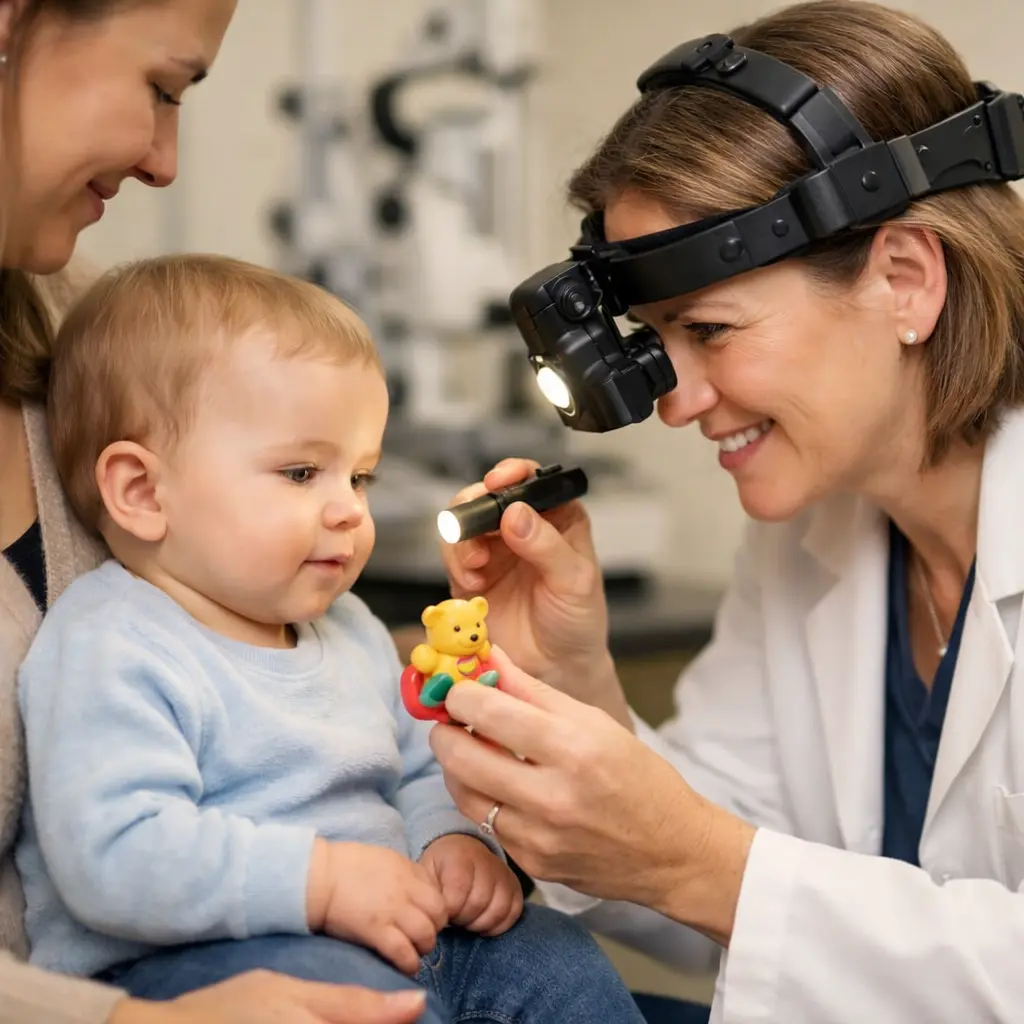
A pediatric eye exam is different from an adult exam. The specialist will:
- Observe how your child uses their eyes
- Check pupil response to light
- Use special drops to dilate the pupils for a thorough internal exam
- Assess eye alignment and movement
- Use age-appropriate methods to estimate refractive error
What If Your Child Is Diagnosed with Vision Loss?
A diagnosis can feel overwhelming, but remember: you are not alone, and there is a path forward.
Common Early Interventions
Depending on the diagnosis, your child may need:
- Glasses or contact lenses for refractive errors
- Patching or eye drops for amblyopia (lazy eye)
- Surgery for conditions like cataracts or strabismus
- Early intervention services through your state’s program (Part C of IDEA)
- Vision therapy with a trained professional
Building Your Support Team
You’ll want to assemble a team that may include:
- Pediatric ophthalmologist or optometrist
- Early intervention specialist
- Teacher of the visually impaired (TVI)
- Occupational therapist
- Orientation and mobility specialist
Frequently Asked Questions (SSS)
Q: My 4-month-old still has eyes that sometimes cross. Is this normal?
A: Intermittent crossing in the first few months can be normal as eye coordination develops. However, if the crossing is constant or persists past 4-6 months, or if one eye always turns in or out, have it checked by a professional.
Q: Can too much screen time cause vision loss in babies?
A: Screen time doesn’t cause permanent vision loss, but it can contribute to eye strain and may displace other important developmental activities. The AAP recommends avoiding screens for children under 18-24 months, except for video chatting.
Q: My toddler seems to see fine. Why do they need an eye exam?
A: Some vision problems have no obvious signs. Conditions like amblyopia (lazy eye) can develop without noticeable symptoms, and if not treated by age 7-8, vision loss can become permanent. Routine screening is essential.
Q: What is the red reflex test, and why is it important?
A: The red reflex test is done with a special light (ophthalmoscope) to look for the normal red reflection in the back of the eye, like in photos. An abnormal reflex (white spot) can indicate serious conditions like cataracts, retinoblastoma (eye cancer), or other internal eye problems. This test should be done at every well-child visit.
Q: My baby was premature. Are they at higher risk for vision problems?
A: Yes. Premature babies, especially those born before 30 weeks or with very low birth weight, are at higher risk for conditions like retinopathy of prematurity (ROP), strabismus, and refractive errors. They should have regular eye exams with a pediatric ophthalmologist.
Conclusion: Trust Your Eyes and Your Instincts
You know your child better than anyone. If something feels off—if their eyes don’t track, if they don’t seem to recognize you, if they bump into things more than seems typical—trust that feeling. Recognizing the early signs of vision loss in infants and toddlers is the first, most critical step. Early detection opens the door to early intervention, and early intervention opens the door to the best possible outcomes. Your vigilance today can shape your child’s visual future. Be observant, be proactive, and be your child’s strongest advocate. Their world is waiting to be seen, and with your help, they’ll see it as clearly as possible.