instagram.com/SpecialKidsEducation
Does your child grip a pencil so tightly that their hand hurts? Do they struggle to form letters or space words on a page? Do they know what they want to say but can’t seem to get it onto paper? These struggles could be signs of dysgraphia—a specific learning disability that affects writing. Dysgraphia in children is not about laziness or lack of effort. It’s a neurological difference that makes the physical act of writing, spelling, and organizing thoughts on paper extremely challenging. The good news is that with the right strategies, accommodations, and tools, children with dysgraphia can become confident writers. This guide will help you recognize the symptoms, provide practical at-home activities, and introduce assistive technology that changes everything.
What Is Dysgraphia? More Than Just Messy Handwriting
Dysgraphia in children is a learning disability that impacts writing skills. It can affect handwriting, spelling, and the ability to put thoughts into written words. Importantly, dysgraphia is not a reflection of intelligence. Many children with dysgraphia have strong verbal skills and creative ideas—they just struggle to express those ideas in writing. Understanding this difference is key to providing compassionate, effective support. This understanding of learning differences is central to our pillar resource, Understanding Learning Disabilities in Children.
Dysgraphia often co-occurs with other learning disabilities, such as dyslexia. However, it can also exist on its own. Recognizing the specific challenges of dysgraphia in children allows parents and teachers to target interventions that address writing mechanics, not just content.
Symptoms of Dysgraphia in Children: What to Look For
Signs of dysgraphia in children vary by age. Early recognition leads to earlier support.
Signs in Preschool and Kindergarten
- Awkward pencil grip (fist grip, wrapping thumb over fingers).
- Difficulty with fine motor tasks like cutting, drawing, or stringing beads.
- Letter formations that are inconsistent or reversed past age 6-7.
- Complaints of hand pain or fatigue during drawing or tracing activities.
Signs in Elementary School (Grades 1-4)
- Illegible handwriting; letters are different sizes, not on the line, or poorly spaced.
- Slow, labored writing—much slower than peers.
- Inconsistent spelling; the same word may be spelled multiple ways on the same page.
- Trouble with sentence construction and organizing thoughts on paper.
- Mixed printing and cursive within the same word.
- Strong verbal storytelling but very weak written output.
Signs in Older Children (Grades 5 and Up)
- Continued poor handwriting despite years of practice.
- Difficulty taking notes; may copy only a fraction of what’s on the board.
- Struggles with planning and writing multi-paragraph essays.
- Avoidance of writing tasks; frustration, anxiety, or meltdowns around writing.
- Writes much less than peers and often doesn’t complete written assignments.
Effective At-Home Activities for Dysgraphia
These at-home activities build fine motor skills, handwriting fluency, and writing confidence. Keep sessions short, playful, and pressure-free.
Fine Motor and Hand Strengthening Activities
Before working on handwriting, build hand strength and coordination.
- Playdough and Theraputty: Rolling, pinching, and hiding objects in putty builds intrinsic hand muscles.
- Tongs and tweezers: Pick up small objects (beans, pom-poms, beads) and move them between containers.
- Water sprayers and squirt guns: Squeezing builds hand strength while feeling like play.
- Stringing beads or lacing cards: Develops the pincer grasp and bilateral coordination.
Multisensory Handwriting Practice
Writing with paper and pencil isn’t the only way to practice. These multisensory activities reduce pressure while building letter formation skills.
- Sand or salt tray: Write letters with a finger in a shallow tray of sand or salt. The sensory feedback helps memory.
- Shaving cream on a tray: Spread shaving cream and practice writing letters or words with a finger. It’s messy, fun, and effective.
- Chalk on the sidewalk: Large arm movements help build motor memory for letter shapes.
- Letter formation with a stylus on a tablet: Some children find digital writing easier than physical writing.
Reduce Writing Load Without Reducing Learning
The goal isn’t to eliminate writing—it’s to reduce the burden so your child can focus on content.
- Be their scribe: Have your child tell you what to write. They dictate; you write. This separates the mechanics of writing from the creativity of ideas.
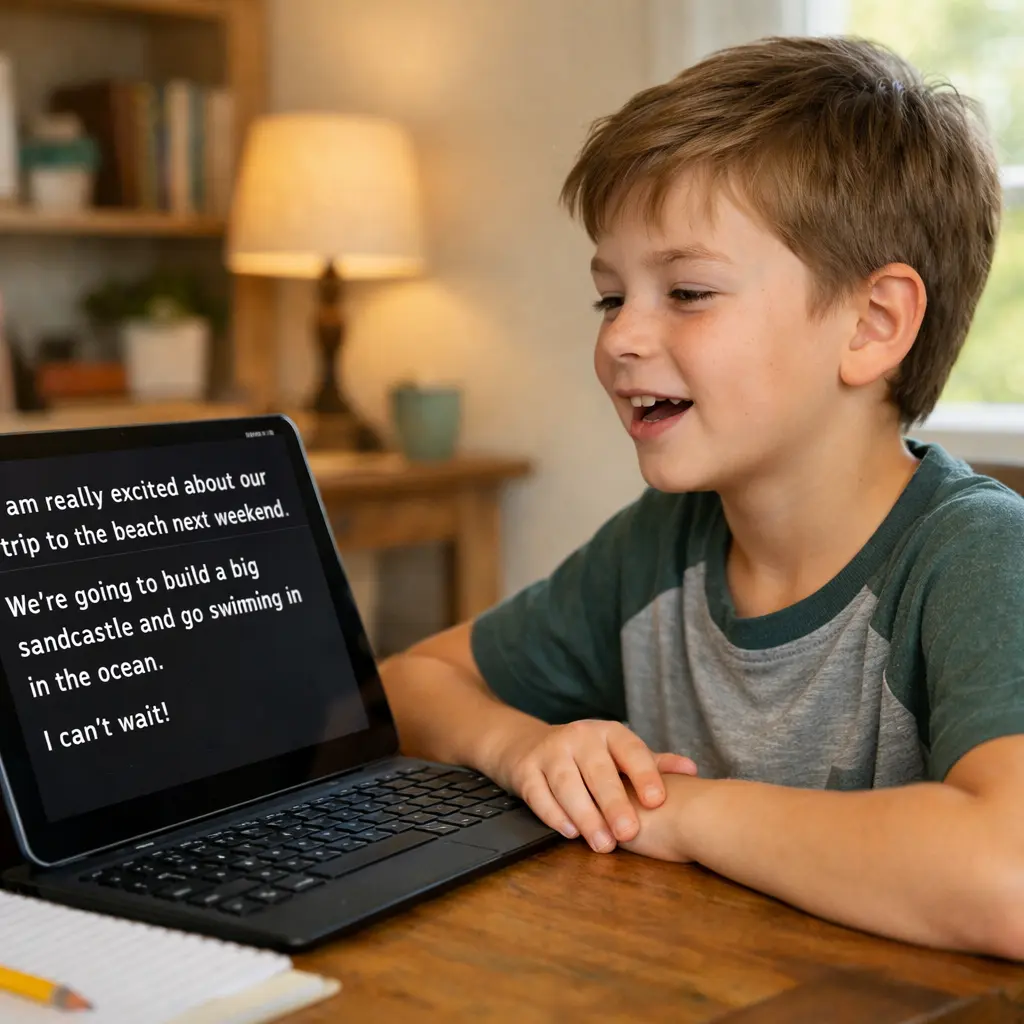
- Use speech-to-text: Your child can speak their ideas, and technology transcribes them.
- Provide sentence starters or graphic organizers: Reduce the cognitive load of “how to start.”
- Accept typed or dictated assignments: For homework, allow digital or oral responses when the goal is content, not handwriting practice.
Assistive Technology Tools for Dysgraphia
Assistive technology is a game-changer for dysgraphia in children. These tools remove barriers and let children demonstrate what they know.
Speech-to-Text Software
Speech-to-text converts spoken words into written text. It’s ideal for brainstorming, drafting, and answering questions when writing is the barrier.
- Built-in options: Google Docs voice typing (free), Apple dictation, Windows dictation.
- Standalone apps: Dragon Naturally Speaking (highly accurate, more expensive).
Word Prediction Software
Word prediction suggests words as the child types, reducing spelling load and increasing writing speed.
- Co:Writer, WordQ, or built-in tools: Many have free trials. Often available through school accommodations.
Text-to-Speech for Proofreading
Children with dysgraphia often can’t see their own spelling or grammar errors. Text-to-speech reads their writing aloud, making errors obvious.
- Built-in tools: Most devices have “read aloud” features.
- Apps: Natural Reader, Voice Dream Reader.
Alternative Keyboards and Digital Tools
- Tablet with a stylus: Some children find digital writing easier than paper and pencil. Apps like GoodNotes or Notability allow practice with less resistance.
- Portable word processor: Devices like Alphasmart (older but reliable) or a simple laptop allow typing without distraction.
- Graphic organizer software: Inspiration or Kidspiration helps children map out ideas before writing.
Classroom Accommodations for Dysgraphia
Accommodations level the playing field. These should be documented in a 504 Plan or IEP.
- Provide typed or oral responses for assessments: When the goal is content, allow alternatives to handwriting.
- Allow use of assistive technology (speech-to-text, word prediction): In class and on tests.
- Provide notes or outlines in advance: So the child isn’t trying to copy and listen at the same time.
- Reduce the length of written assignments: Focus on quality, not quantity.
- Grade for content, not handwriting: When the goal is knowledge, handwriting shouldn’t be penalized.
- Allow extra time on written tasks: Writing takes longer. Extra time is essential.
- Use paper with raised lines or colored guidelines: Provides tactile and visual cues for letter placement.
- Allow typed homework and tests: Typing is often much easier than handwriting.
For a step-by-step guide to documenting these accommodations in a formal plan, see How to Request an IEP for a Learning Disability: A Step-by-Step Parent Guide.
Supporting Writing Without Burning Out
Writing is exhausting for children with dysgraphia. They may come home from school completely drained after a day of writing tasks. Here’s how to protect their energy and build resilience.
- Limit after-school writing: If they’ve done a lot of writing at school, let homework be oral or typed.
- Build in breaks: Five minutes of writing, then two minutes of stretching or movement.
- Celebrate effort, not just output: “I saw how hard you worked on that sentence. Great persistence!”
- Keep a positive writing environment: No shame, no criticism of handwriting. Focus on ideas.
- Teach typing skills early: Typing can be a lifeline. Use fun typing programs (TypingClub, Dance Mat Typing) to build fluency without pressure.
Emotional Support: Building Confidence as a Writer
Children with dysgraphia often internalize negative messages. “I’m bad at writing.” “I’m stupid.” “Everyone else can do this but me.” You can counteract these beliefs.
- Talk openly about dysgraphia: “Your brain has a hard time turning ideas into written words. That’s not your fault. We’re going to find tools that work for you.”
- Focus on their ideas, not the mechanics: “That was a really creative story idea. Tell me more.”
- Share examples of successful people with dysgraphia: Many writers, artists, and entrepreneurs have dysgraphia.
- Advocate for accommodations without apology: “Using speech-to-text isn’t cheating. It’s how you show what you know.”
Frequently Asked Questions (SSS)
Q: Is dysgraphia just messy handwriting?
A: No. Messy handwriting can be a symptom, but dysgraphia is much broader. It affects spelling, sentence construction, organizing thoughts on paper, and the physical act of writing. A child can have neat handwriting and still have dysgraphia if writing is extremely slow, painful, or disorganized.
Q: Can a child with dysgraphia learn to write legibly?
A: Many children improve with explicit, multisensory instruction and occupational therapy. But for some, handwriting will always be effortful. The goal isn’t perfect handwriting—it’s functional writing and finding alternative ways to express ideas.
Q: Will my child outgrow dysgraphia?
A: Dysgraphia is a lifelong condition. However, with the right strategies, accommodations, and assistive technology, the impact of dysgraphia can be greatly reduced. Children learn to work with their brain, not against it.
Q: What should I do if I suspect my child has dysgraphia?
A: First, talk to your child’s teacher. Ask what they’re seeing in the classroom. Then, request a formal evaluation from the school district (in writing). An occupational therapy evaluation can assess fine motor and handwriting skills. A comprehensive evaluation can identify dysgraphia and other co-occurring learning disabilities.
Q: Should I stop my child from using assistive technology so they practice handwriting?
A: No. Assistive technology is not a crutch—it’s a tool for access. Children with dysgraphia need explicit handwriting instruction, but they also need to be able to demonstrate their knowledge without being held back by writing mechanics. Use both: handwriting practice for skill-building, assistive technology for real learning and expression.
Conclusion: Writing Is Just One Way to Share Ideas
Recognizing dysgraphia in children early and providing the right tools and strategies transforms their relationship with writing. Without support, writing is a source of frustration, shame, and avoidance. With support, it becomes a manageable—and sometimes even enjoyable—way to share ideas. Your child has stories to tell, opinions to share, and knowledge to demonstrate. Writing is just one path. With your advocacy, the right accommodations, and assistive technology, they’ll find their voice—on paper, on a screen, or spoken aloud. And that voice will be powerful.