instagram.com/SpecialKidsEducation
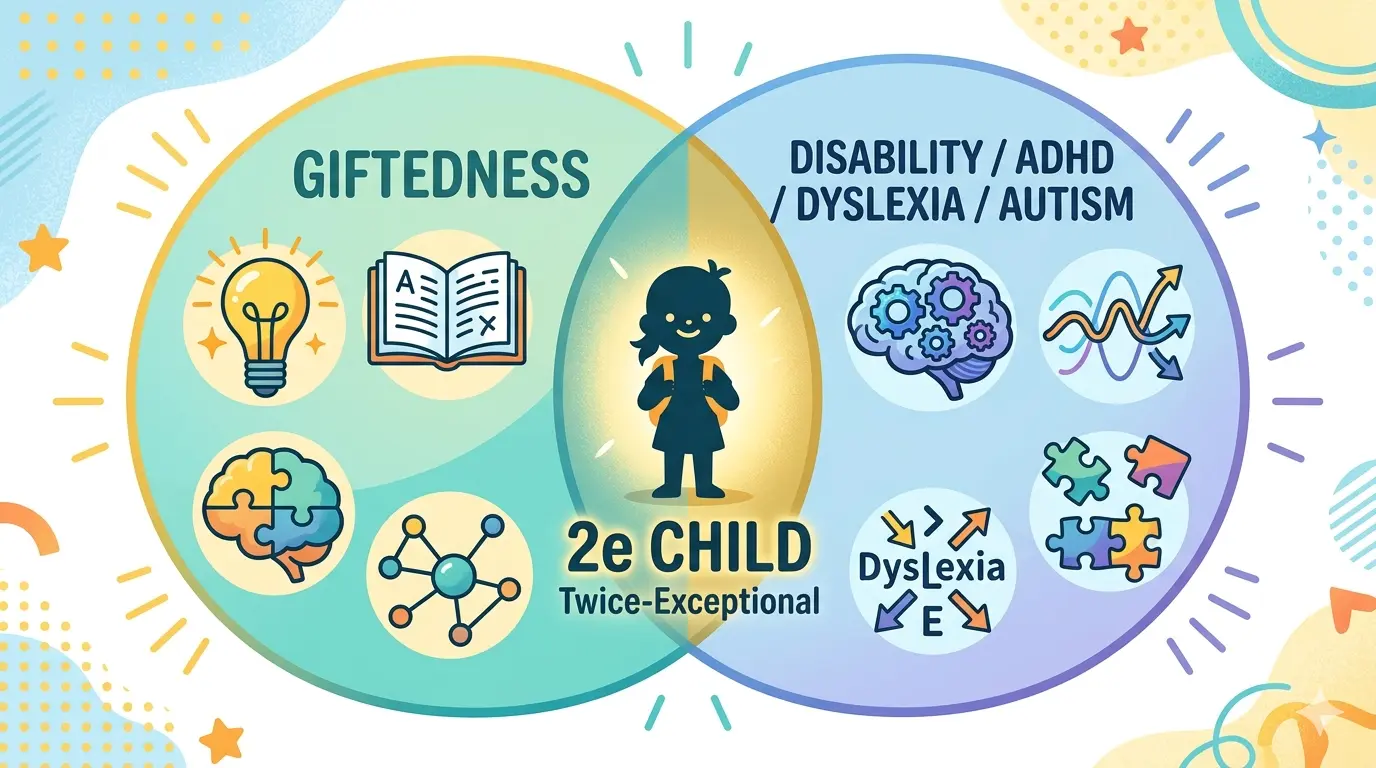
Imagine a child who can build complex structures with LEGOs and explain planetary science in striking detail—but can’t write a simple sentence or remember to turn in homework. Imagine a child who reads at a high school level but melts down when the daily routine changes. These children are not contradictions. They are twice-exceptional—gifted in some areas and facing significant challenges in others. Understanding twice-exceptional (2e) children requires moving beyond simple labels. These learners have extraordinary potential AND learning or developmental differences. Without proper identification and support, their gifts may mask their disabilities—or their disabilities may hide their gifts. This guide will help you recognize the signs of twice-exceptional (2e) children, understand common profiles (gifted with ADHD, gifted with dyslexia, gifted with autism), and advocate for the integrated support these complex learners need to thrive.
What Does Twice-Exceptional Mean? Understanding the 2e Profile
The term twice-exceptional (2e children) refers to students who are identified as gifted in one or more areas AND also have a learning disability, neurodevelopmental condition, or other diagnosed challenge. The “twice” means they have exceptional abilities (giftedness) and exceptional needs (disability). These two aspects interact in complex ways. The giftedness may compensate for the disability, allowing the child to perform at average levels despite significant challenges. Conversely, the disability may mask the giftedness, making the child appear average or even below average.
Because of this complexity, twice-exceptional (2e children) are often missed by both gifted programs and special education. They may be seen as lazy, unmotivated, or behavior problems. In reality, they are navigating a brain that is wired for both extraordinary strengths and significant struggles. Understanding this interaction is central to our pillar resource, Gifted and Talented Education: Nurturing Exceptional Potential.
Why Twice-Exceptional Children Are Often Misunderstood
The twice-exceptional (2e children) profile creates a “masking effect” that leads to frequent misidentification. Here’s how it works:
- Giftedness masks disability: A child with dyslexia who has strong verbal reasoning and memory may compensate and read at grade level—but at great cost. Teachers see average reading scores and miss the underlying struggle. A child with ADHD who is highly interested in a topic can hyperfocus, masking attention issues in that context.
- Disability masks giftedness: A child with autism who has extraordinary mathematical abilities may struggle with communication or sensory overload, causing them to underperform on tests. A child with written expression disorder may have brilliant ideas but can’t get them on paper, appearing less capable than they are.
- Asynchronous development intensifies the disconnect: A 2e child may have the intellectual capacity of a 14-year-old, the emotional regulation of a 7-year-old, and the fine motor skills of a 5-year-old. This uneven profile confuses traditional assessments and frustrates teachers who expect consistency.
Because of this masking, many twice-exceptional (2e children) are never identified for gifted programs—or are identified only for their struggles and receive special education without enrichment.
Common Profiles of Twice-Exceptional Children
While every 2e child is unique, certain profiles appear frequently. Understanding these patterns helps parents and teachers recognize potential 2e learners.
Gifted with ADHD
This is one of the most common 2e profiles. These children are highly creative, curious, and able to hyperfocus on topics of interest—but struggle with sustained attention on non-preferred tasks, organization, impulse control, and emotion regulation.
- Signs to look for: Intense focus on passion areas, but unable to complete routine tasks. Highly creative problem-solving but disorganized work. Asks deep, insightful questions but blurts out answers or interrupts. Big ideas but difficulty with follow-through.
- Common misperceptions: “They’re lazy.” “They could do it if they tried harder.” In reality, their brain has difficulty regulating attention and motivation. The giftedness and ADHD interact—the giftedness can’t “overcome” the ADHD, and the ADHD doesn’t negate the giftedness.
Gifted with Dyslexia
Children with this profile have extraordinary verbal reasoning, problem-solving, or creative abilities alongside significant difficulty with decoding, spelling, or reading fluency.
- Signs to look for: Strong listening comprehension but poor reading comprehension on tests that require decoding. Advanced vocabulary when speaking but simple spelling in writing. Creative, big-picture thinking but trouble with rote memorization or phonics. May hate reading but love being read to.
- Common misperceptions: “They can’t be gifted because they can’t read well.” In reality, dyslexia is about decoding, not intelligence. These children often have exceptional reasoning and problem-solving skills that are not captured by reading-based assessments.
Gifted with Autism (Level 1)
These children have advanced abilities in specific areas—often pattern recognition, memory, math, or system-based topics—alongside social communication challenges, sensory sensitivities, and difficulty with flexibility and change.
- Signs to look for: Deep, encyclopedic knowledge of specific interests. Exceptional memory for facts, dates, or details. Strong logical reasoning but difficulty with abstract social concepts. May struggle with group work, transitions, or open-ended assignments despite high intellectual ability.
- Common misperceptions: “They’re just quirky.” “They’re not trying to be social.” In reality, their brain processes social information differently. They need explicit teaching of social skills—not punishment for not intuitively understanding them.
Gifted with Anxiety or Depression
Children with this profile may have extraordinary intellectual abilities but are paralyzed by perfectionism, fear of failure, or existential concerns that interfere with daily functioning.
- Signs to look for: Extremely high standards for themselves. Avoidance of challenging tasks for fear of not being perfect. Intense worry about future, global issues, or others’ perceptions. Physical symptoms (stomachaches, headaches) before tests or presentations.
- Common misperceptions: “They’re just dramatic.” “They need to toughen up.” In reality, giftedness often comes with intense emotional sensitivity and overexcitabilities that require specific coping strategies.
Gifted with Sensory Processing Challenges
These children have strong cognitive abilities but are overwhelmed by sensory input—noise, light, textures, or certain physical sensations—making school environments physically uncomfortable and distracting.
- Signs to look for: Covers ears in noisy environments (cafeteria, assembly). Avoids certain clothing textures or foods. Overwhelmed by bright or fluorescent lights. Intense reactions to unexpected touch or movement. May shut down or have meltdowns after overstimulation.
- Common misperceptions: “They’re being difficult on purpose.” In reality, sensory processing challenges are neurological, not behavioral. The child is not choosing to be overwhelmed.
Recognizing the Signs: When to Suspect 2e
Because twice-exceptional (2e children) often mask their struggles or gifts, parents and teachers need to look for patterns—not isolated traits.
- Uneven performance: Striking differences between strengths and weaknesses. A child who aces oral tests but fails written ones. A child who understands complex math concepts but can’t memorize math facts.
- Intensity and sensitivity: Extreme reactions to frustration, failure, or perceived unfairness. Deep emotional responses to art, music, or nature.
- Boredom and disengagement in some settings but deep engagement in others: A child who seems lazy or resistant in class but has passionate, focused interests at home.
- Compensatory behaviors that mask struggle: A child who refuses to read aloud not because of defiance but because decoding is exhausting. A child who jokes or distracts when asked to write not because of attitude but because writing is painfully slow.
- Underachievement: Performing below potential, especially in areas of difficulty, despite clear strengths elsewhere.
- Perfectionism or avoidance: Refusing to try tasks where they might not succeed immediately.
Why Twice-Exceptional Children Are Often Misdiagnosed
The complex profile of twice-exceptional (2e children) makes them vulnerable to misdiagnosis. Intense focus on interests can look like ADHD? Yes. But children with ADHD who are 2e may hyperfocus differently. Social challenges can look like autism? Yes. But gifted children without autism may also struggle with peer relationships due to asynchronous development. Perfectionism and worry can look like anxiety disorders? Yes. But gifted children often have existential concerns that are intellectual rather than pathological.
If you suspect your child may be 2e, seek an evaluator who understands both giftedness and learning disabilities. A typical school evaluation may miss the giftedness because the disability is more apparent—or may miss the disability because the child is compensating.
For a step-by-step guide to requesting an evaluation and securing appropriate supports, see How to Request an IEP for a Learning Disability: A Step-by-Step Parent Guide.
Supporting Twice-Exceptional Children at School
Supporting twice-exceptional (2e children) in school requires both challenge and support. The goal is not to remediate all weaknesses before allowing enrichment—both are needed simultaneously.
- Differentiated instruction that addresses both strengths and weaknesses: A 2e child needs advanced content in their strength areas AND explicit instruction in areas of difficulty—not one category at the expense of the other.
- Accommodations that reduce barriers: Extended time, text-to-speech for reading, speech-to-text for writing, preferential seating, movement breaks.
- Access to gifted programming: 2e children need intellectual challenge just as much as other gifted children. Don’t exclude them because of their struggles.
- Social-emotional support: Counseling, social skills groups, or mentoring to address frustration, perfectionism, and peer relationships.
- Strength-based approach: Use the child’s passions as the doorway to learning. A child with dyslexia who loves astronomy reads about space (with support) rather than being forced through endless phonics drills.
Supporting Twice-Exceptional Children at Home
Parents of twice-exceptional (2e children) walk a delicate line—pushing enough to challenge without creating overwhelm, supporting without excusing.
- Validate both the struggle and the potential: “Reading is really hard for you right now. That’s not your fault. But you also have an amazing ability to solve complex problems. We’re going to support you in both areas.”
- Separate skill from will: Assume your child wants to succeed. Struggles are about missing skills—not lack of effort.
- Celebrate effort in areas of difficulty and achievement in areas of strength: A 2e child needs to feel capable somewhere.
- Advocate for integrated support at school: 2e children often fall between departments (gifted vs. special education). You may need to advocate for both.
- Protect their self-esteem: The child who struggles with writing but has brilliant ideas needs to hear that they are smart—but also needs honest support for their challenges.
Frequently Asked Questions (SSS)
Q: How can a child be both gifted and have a learning disability? Isn’t that a contradiction?
A: It only seems like a contradiction if you assume giftedness means being good at everything. Giftedness means exceptional ability in specific areas—often verbal, mathematical, spatial, or creative domains. A child can have extraordinary reasoning skills and still struggle with reading, writing, or attention. The brain is complex. Strengths and weaknesses can coexist.
Q: My child was identified as gifted but is struggling in school. Could they be 2e?
A: Yes. Many 2e children are first identified as gifted (because their strengths are obvious) before their struggles are recognized. If your gifted child is underachieving, seems lazy, has extreme reactions to frustration, or has huge gaps between verbal and written performance, consider a 2e evaluation.
Q: What kind of professional evaluates for twice-exceptionality?
A: Look for a psychologist or neuropsychologist with specific experience in both giftedness and learning disabilities/ADHD/autism. Many psychologists understand one area but not the other. Ask: “Have you evaluated 2e children before? How do you differentiate between gifted behaviors and disability symptoms?”
Q: My child was diagnosed with ADHD/dyslexia/autism but never identified as gifted. Could they be 2e?
A: Absolutely. Often, the disability is more visible than the giftedness, especially in school settings where weaknesses are the focus. If your child has intense passions, exceptional memory in specific areas, creative problem-solving, or advanced reasoning despite their challenges, they may be 2e.
Q: How do I help my 2e child feel successful when they struggle every day?
A: Focus on their strengths—protect time for their passions. Celebrate small wins. Separate their identity from their struggles. “You have a reading challenge, but you are not stupid. You have amazing ideas. We’ll find a way to get them out.” And consider outside-of-school activities where they can excel—robotics, art, coding, music, community service.
Conclusion: Seeing the Whole Child
Recognizing and supporting twice-exceptional (2e children) requires a shift in perspective. Instead of seeing them as contradictory or confusing, see them as whole children—with extraordinary strengths and significant struggles, both of which need attention. These children are not broken. They are not lazy. They are not faking. They are wired differently—for brilliance and for challenge. When both their giftedness and their disabilities are recognized and supported, they can flourish. They can learn to read, write, focus, and navigate the social world—not by hiding their struggles, but by working with them. Your advocacy, your belief, and your willingness to see the whole child are what will help them thrive. For more on understanding giftedness, revisit our guide on the signs of a gifted child for context on the abilities that are part of the 2e profile.