instagram.com/SpecialKidsEducation

,For any parent, watching your child navigate the social world can bring both joy and worry. Will they make friends? Will they be included? Will they feel lonely? For parents of a child with vision loss, these questions often carry extra weight. Social skills—the ability to connect, communicate, and build friendships—are largely learned through visual observation. A sighted child watches how peers greet each other, notices facial expressions, and learns social cues almost without trying. When a child has vision loss, these critical lessons don’t come automatically. But here’s the encouraging truth: with intentional support, children with vision loss can develop strong social skills in children with vision loss and form deep, lasting friendships. This guide will walk you through the unique social challenges these children face and provide practical, everyday strategies to help your child build confidence, connection, and meaningful relationships.
Why Social Skills Can Be More Challenging for Children with Vision Loss
To understand how to support social skills in children with vision loss, we first need to understand what makes social learning different for them. Social skills are often called the “hidden curriculum” because so much of them is learned indirectly. A sighted child absorbs countless social lessons without direct instruction:
- They see two people greet each other with a handshake or a wave.
- They notice how close to stand when talking to someone.
- They observe facial expressions and learn to read emotions.
- They watch turn-taking in conversations and play.
A child with vision loss misses most or all of these visual cues. They may not know that someone is smiling at them, that a peer is waving hello, or that a group has turned away, signaling the conversation is over. This isn’t a lack of social desire—it’s a lack of access to the information most children get through their eyes. Recognizing this gap is the first step in intentionally teaching the skills that other children learn by watching. This understanding of developmental differences is central to our pillar resource, Understanding Vision Loss in Children: Causes, Signs, and Support Strategies.
The Building Blocks of Social Success
When we talk about nurturing social skills in children with vision loss, we’re really talking about teaching a set of specific, learnable abilities. Think of these as the foundation stones of friendship.
Conversation Skills: The Art of Back-and-Forth
- Initiating: Teach your child how to start a conversation. Role-play simple openers like “Hi, what’s your name?” or “What are you playing?” Practice the tone of voice—friendly, not too loud or quiet.
- Turn-Taking: Use games to practice the rhythm of conversation. Take turns describing something, asking a question, or commenting. A simple “talking stick” can make this concrete.
- Staying on Topic: Practice having a conversation about one subject for several turns. Use prompts like “Let’s talk about our favorite animals. I’ll go first, then you, then back to me.”
- Asking for Clarification: This is a superpower. Teach phrases like “I didn’t catch that, can you say it again?” or “Can you describe that for me?” Practice them until they feel natural.
Understanding Nonverbal Communication: Learning What You Can’t See
Since your child can’t see facial expressions and body language, you need to become their eyes, describing the social world around them.
- Describe emotions: “My voice sounds happy right now because I’m smiling. When I’m surprised, my eyes open wide and I might say ‘Oh!'” Let them touch your face to feel a smile or a surprised expression.
- Explain body language: “When someone crosses their arms like this (demonstrate), they might feel closed off or upset. When they lean in like this, they’re interested in what you’re saying.”
- Use audio description: Watch movies or TV shows together and describe what’s happening visually, especially character interactions. “See how she’s looking down and her shoulders are slumped? She looks sad.”
Personal Space and Body Awareness
Understanding where your body ends and someone else’s begins is a critical social skill that’s learned visually. Children with vision loss need explicit teaching.
- The “arm’s length” rule: Teach your child to extend their arm; that’s generally a good distance for conversation.
- Practice with a peer: Have a friend or family member stand at different distances and ask your child to identify when it feels “too close” or “too far.”
- Use a hula hoop: Have your child stand in a hula hoop and explain that this is their personal space. Others should stay outside unless invited in.
Perspective-Taking and Empathy
Friendship requires understanding another person’s point of view—something that’s harder to grasp without visual cues.
- Talk through real situations: “Your friend sounded quiet on the phone today. How do you think she was feeling? What could we do to help?”
- Use stories: While reading books together, pause and ask, “How do you think that character feels right now? How can you tell?”
- Name your own feelings: “I’m feeling frustrated because I can’t find my keys. When I’m frustrated, my voice might sound a little tight.”
Practical Strategies for Parents: Creating Opportunities for Connection
You are your child’s first and most important social coach. Here are practical ways to support social skills in children with vision loss through everyday life.
Start with You: Be the Social Mirror
Your interactions with your child are their first social lessons. Narrate your own social exchanges. “I’m going to say hello to our neighbor now. I’ll smile and wave and say ‘Good morning!’ Listen to how my voice sounds—friendly and warm.” When you’re on the phone, describe the conversation afterward. “That was Grandma. She asked how we’re doing, and I told her about our day. Then we said goodbye.”
Create Intentional, Supported Playdates
Unstructured social time can be overwhelming for a child with vision loss. Set up playdates with a clear plan.
- Keep it small: Start with one familiar friend, not a group.
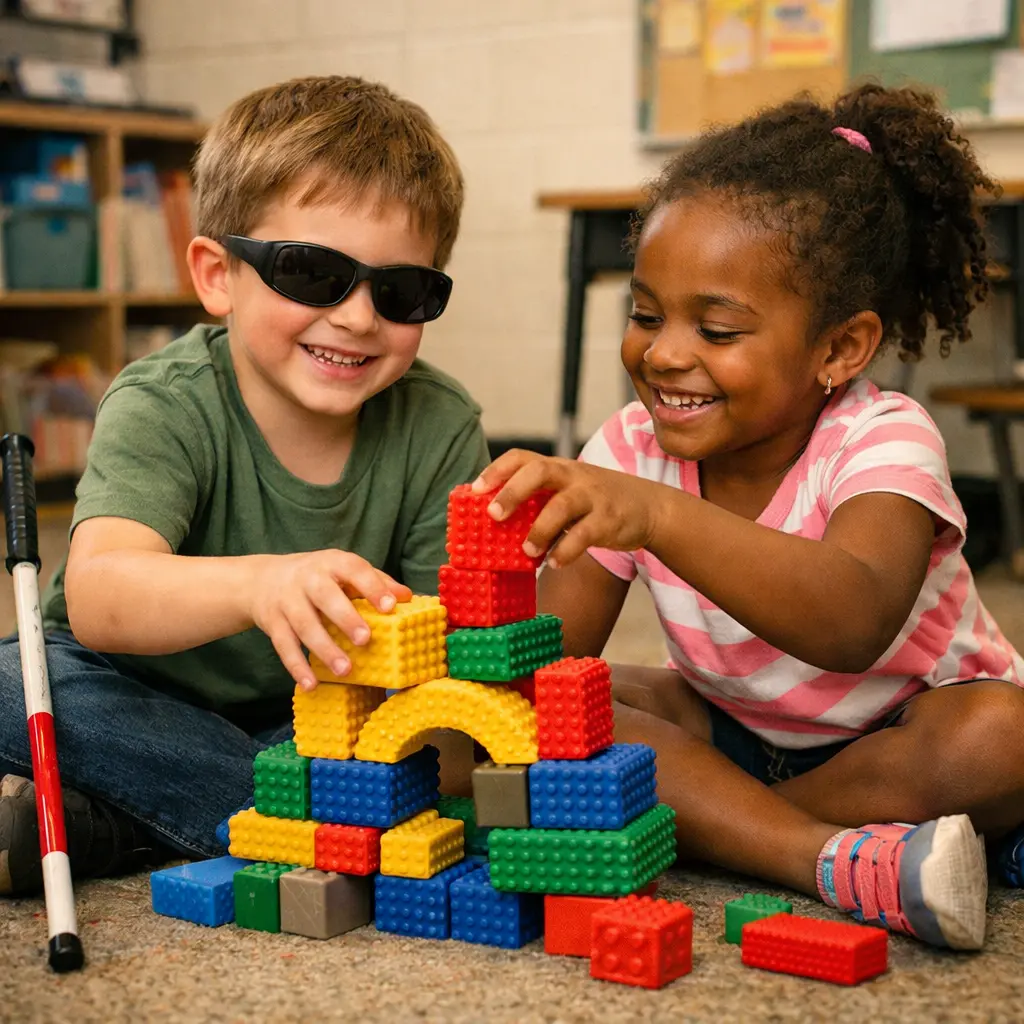
- Choose the right activity: Pick something structured with clear boundaries—building with LEGOs, playing with playdough, making a simple craft, or listening to an audiobook together. Activities that don’t rely heavily on vision level the playing field.
- Briefly prepare the friend: A simple, positive explanation can make a huge difference. “Sarah can’t see well, so she might need you to describe what you’re doing or touch your arm before you talk to her. But she loves playing and is really fun!”
- Stay nearby but don’t hover: Be available to gently facilitate if needed, but let them lead. If you notice a breakdown, step in with a suggestion rather than taking over.
Enroll in Group Activities
Structured group settings like music classes, adaptive sports, or Girl/Boy Scouts provide natural opportunities for social interaction with built-in support.
- Music classes: Great for auditory learners and often highly structured.
- Adaptive sports: Beep baseball, goalball, or swimming provide physical activity and team connection in a vision-friendly way.
- Pre-communicate with leaders: Talk to the coach or teacher beforehand. Share a few simple strategies for including your child, and offer to help if needed.
Teach Self-Advocacy: Giving Your Child a Voice
Your child needs to feel empowered to speak up about their needs. This is a gift that will serve them for life.
- Practice simple scripts: “I can’t see that, can you describe it?” “Can you tap my arm before you talk so I know you’re there?” “I need to sit closer to hear better.”
- Role-play different scenarios: What to do if someone walks away mid-conversation, how to ask to join a game, how to respond if someone is unkind.
- Celebrate their courage: When your child uses their voice, acknowledge it. “That was brave to tell your friend you needed help. I’m proud of you.”
Build Your Village: Connect with Other Families
Connecting with other families raising children with vision loss can be a lifeline. Local organizations, schools for the blind, or online communities can help you find playmates who “get it.” There’s something powerful about your child having friends who share similar experiences. Check organizations like the American Foundation for the Blind (AFB) or National Federation of the Blind (NFB) for local chapters and family events.
Partnering with the School for Social Success
Your child spends a significant portion of their day at school. Partnering with educators is essential for supporting social skills in children with vision loss in that environment.
Talk to the Teacher of the Visually Impaired (TVI)
Your child’s TVI is a crucial ally. They understand the unique social challenges of vision loss and can work with your child individually or in small groups on skills like conversation, self-advocacy, and interpreting social cues. Ask them to observe your child in social settings like lunch or recess and provide targeted support.
Consider Social Skills Goals in the IEP
If social challenges significantly impact your child’s ability to access their education or form relationships, advocate for specific goals related to social skills in children with vision loss within their IEP. These goals might address turn-taking, initiating interactions, or understanding nonverbal communication. The school team, including the TVI, school psychologist, and counselor, can work together on these goals.
Educate Peers (with Your Child’s Input)
Sometimes, the best support comes from classmates. With your child’s permission and input, work with the teacher on a simple, positive class presentation about vision loss.
- Focus on strengths and similarities: Emphasize that your child likes the same things—music, games, jokes, friends.
- Explain a few helpful tips: “It helps if you say your name before you talk.” “If she doesn’t answer right away, she might not know you’re talking to her—try touching her arm gently.”
- Use an activity: Have classmates try a simple task with a blindfold, like matching socks by feel, to build empathy and understanding.
- Keep it positive: Frame it as “how we can all be good friends” rather than “how to help the poor blind kid.”
When to Seek Extra Support
While many children develop social skills with consistent support, some benefit from professional help.
- Social skills groups: Some therapists and organizations run groups specifically for children with vision loss or other disabilities. These provide a safe, structured environment to practice with peers who face similar challenges.
- Counseling: If your child seems withdrawn, anxious, or depressed about social situations, a therapist who understands vision loss can help them process these feelings and build coping strategies.
- Mentors: Connecting your child with an older child or adult who is blind or visually impaired can be incredibly powerful. They offer living proof that a full social life is possible and can share their own strategies.
Frequently Asked Questions (SSS)
Q: My child seems content playing alone. Should I still push them to socialize?
A: It’s a balance. Solitary play is healthy and many children, with or without vision loss, are naturally more introverted. The goal isn’t to force constant social interaction, but to ensure they have the skills to connect when they want to. Gently encourage interaction in comfortable, low-pressure settings. If they consistently resist and seem distressed by social situations, consider seeking an evaluation from a professional to rule out social anxiety.
Q: How do I handle it when my child isn’t invited to birthday parties or playdates?
A: This is heartbreaking, and you’re not alone. First, allow yourself to feel that pain—it’s real. Then, consider proactive steps. Build connections with a few key families by inviting them over first. Educate gently—sometimes exclusion comes from fear or not knowing how to include a child with a disability. Connect with other families of children with vision loss who understand. And always, always come home to your child with love and reassurance, focusing on the connections they do have.
Q: What if other children stare or ask rude questions about my child’s eyes or cane?
A: Children are naturally curious, and their questions are often innocent. Prepare your child with simple, confident responses. “My eyes don’t work well, so I use this cane to help me feel where I’m going.” “My eyes look different, but I can hear you just fine!” Role-play these responses. For the staring child, a simple, friendly explanation from you or the teacher can turn a moment of awkwardness into one of understanding.
Q: My teenager with vision loss is really struggling socially. What can I do differently?
A: Teen social dynamics are complex for everyone, and vision loss adds extra layers. Focus on one-on-one connections rather than large groups. Encourage participation in interest-based activities where socializing happens naturally around a shared passion—music, technology, adaptive sports. Connect them with blind mentors or peers through organizations like the NFB. And keep communication open. Let them know you see their struggle and are there to support, not fix.
Q: Are there specific books or resources that help teach social skills to children with vision loss?
A: Yes! The American Printing House for the Blind (APH) offers resources on social skills. Look for books with clear, descriptive language about emotions and friendships. Social stories—simple, personalized stories about specific social situations—can be incredibly effective. Your child’s TVI can help create these or recommend resources. Also, don’t underestimate the power of well-described movies and TV shows to spark conversations about social dynamics.
Conclusion: Building Bridges of Friendship
Raising a child who navigates the social world with confidence and forms lasting friendships is one of the most rewarding—and sometimes challenging—parts of parenting. Nurturing social skills in children with vision loss requires extra intention, creativity, and patience. There will be moments of heartache and moments of pure joy. The first time your child initiates a conversation with a peer, the first playdate where you hear genuine laughter, the first time they say “Mom, I have a best friend”—these are the moments that make every effort worthwhile. You are not just teaching skills; you are building bridges. You are your child’s first friend, their most consistent advocate, and their guide to a world they can’t always see but can learn to navigate with confidence and connection. Trust the journey, celebrate every small victory, and know that your love and persistence are building a foundation for a lifetime of meaningful relationships.