instagram.com/SpecialKidsEducation
How Speech Therapy Helps Children With Communication Disorders is a critical question for parents who notice their child struggling with speech clarity, vocabulary development, or language comprehension. Understanding how speech therapy helps children with communication disorders allows families to take early, informed action instead of waiting and hoping the problem resolves on its own. When parents understand how speech therapy helps children with communication disorders, they gain clarity about what therapy actually involves, how it supports development, and what realistic progress looks like over time.
Communication is foundational to learning, social interaction, and emotional expression. When these skills are delayed, early and structured intervention can make a significant difference.
What Are Communication Disorders?
Communication disorders include difficulties related to:
- Speech sound production (articulation disorders)
- Fluency issues (stuttering)
- Voice disorders
- Expressive language delay
- Receptive language delay
Children may experience one or a combination of these challenges. The earlier intervention begins, the more effective progress tends to be.
Understanding how speech therapy helps children with communication disorders begins with recognizing that therapy is individualized and tailored to the child’s specific needs.
How Speech Therapy Helps Children With Communication Disorders Through Assessment
Before intervention begins, speech-language pathologists conduct a comprehensive evaluation.
What Professionals Assess
- Sound production and articulation
- Vocabulary size
- Sentence structure
- Comprehension skills
- Social communication abilities
This evaluation helps determine whether a child needs support for speech clarity, language comprehension, or both.
Assessment is typically play-based and interactive, ensuring the child feels comfortable while professionals observe natural communication patterns.
How Speech Therapy Helps Children With Communication Disorders in Practice
Articulation and Sound Production
For children with speech sound disorders, therapy may include:
- Targeted pronunciation practice
- Repetition exercises
- Sound isolation drills
- Gradual progression from single sounds to full sentences
These structured exercises improve clarity and intelligibility over time.
Language Development Support
When language delay is present, therapy focuses on:
- Expanding vocabulary
- Building sentence complexity
- Improving comprehension
- Practicing conversational skills
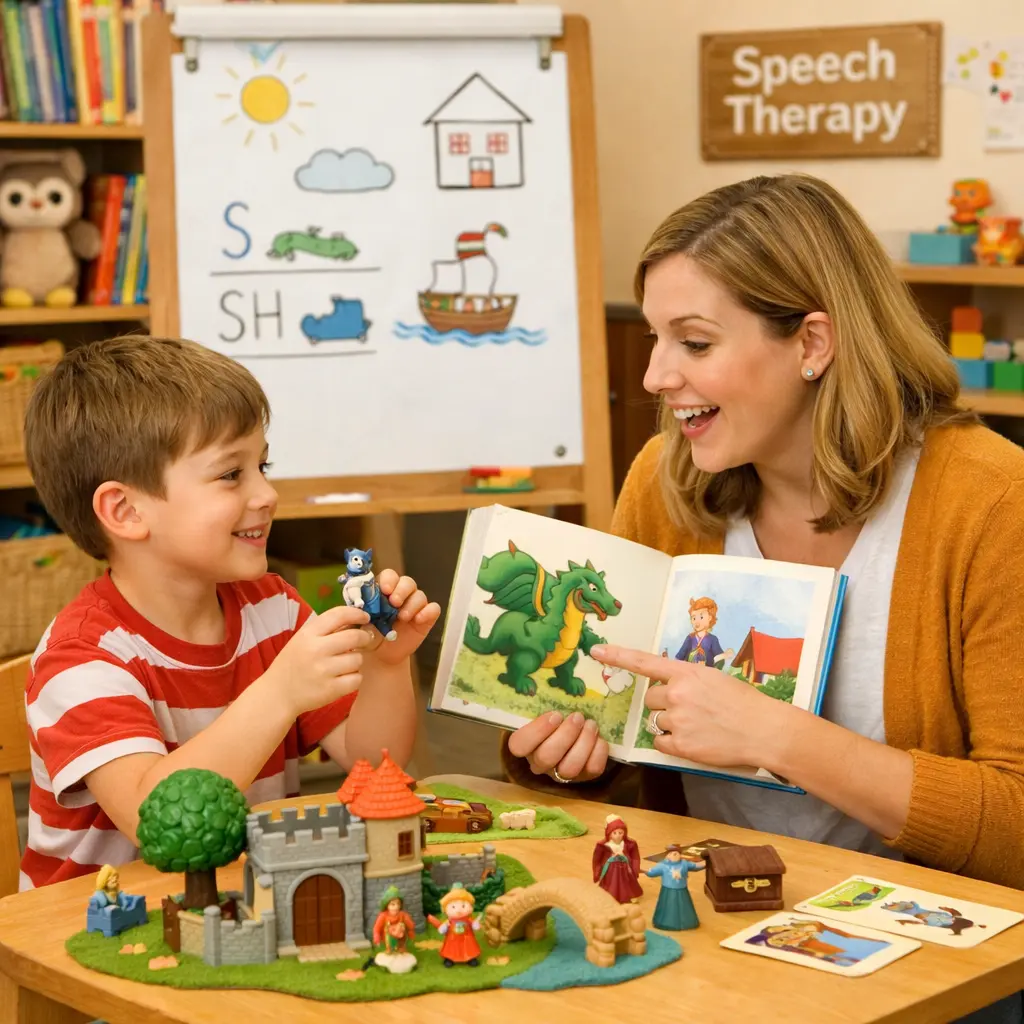
Interactive games, storytelling, and picture-based activities are often used to strengthen language skills in natural ways.
Fluency and Stuttering Intervention
For children who stutter, therapy may include:
- Breathing techniques
- Slow speech pacing
- Confidence-building exercises
- Reducing communication anxiety
Fluency therapy focuses not only on speech rhythm but also on emotional support.
Play-Based Therapy: Why It Works
Many parents are surprised to learn that speech therapy often looks like structured play. Play-based therapy allows children to practice communication skills in motivating, low-pressure settings.
Activities may include:
- Role-playing games
- Story sequencing
- Turn-taking exercises
- Interactive board games
Through repetition and guided interaction, communication skills gradually strengthen.
This explains how speech therapy helps children with communication disorders without creating stress or resistance.
Different Therapy Approaches Used for Communication Disorders
To fully understand how speech therapy helps children with communication disorders, it is important to recognize that therapy methods vary depending on the type and severity of the disorder. Modern speech therapy combines evidence-based techniques with individualized strategies.
Articulation-Based Therapy
This approach focuses on improving specific speech sounds through repetition, modeling, and corrective feedback. Children practice:
- Sound placement techniques
- Controlled repetition
- Gradual progression from words to sentences
- Structured drills with increasing complexity
This method is particularly effective for children with articulation disorders.
Language-Enrichment Therapy
For children with language delay, therapy often emphasizes:
- Expanding vocabulary
- Modeling correct sentence structure
- Guided storytelling
- Comprehension-building exercises
Language-enrichment sessions are interactive and often incorporate visual supports, picture cards, and structured conversation prompts.
Social Communication Therapy
Some children struggle primarily with pragmatic language skills—such as maintaining conversation or interpreting social cues. In these cases, therapy may include:
- Role-playing scenarios
- Practicing eye contact and turn-taking
- Interpreting facial expressions
- Structured peer interaction activities
This demonstrates how speech therapy helps children with communication disorders beyond pronunciation and vocabulary.
Parent-Coaching Models
Many therapists incorporate parent coaching to ensure skills are reinforced at home. Caregivers learn modeling techniques, prompting strategies, and daily communication-building practices.
Because communication development occurs throughout the day, parent involvement significantly increases therapy effectiveness.
These varied approaches illustrate how speech therapy helps children with communication disorders through flexible, targeted, and research-based strategies.
How Speech Therapy Helps Children With Communication Disorders at School
Speech therapy often extends beyond private sessions into school environments.
School-Based Support May Include:
- Classroom collaboration
- Individualized Education Plans (IEPs)
- Small-group language sessions
- Teacher strategy recommendations
When therapy aligns with classroom expectations, children experience more consistent progress.
Parental Involvement: A Key Factor in Progress
One of the most important aspects of how speech therapy helps children with communication disorders is parental involvement.
Speech-language pathologists frequently:
- Provide home practice suggestions
- Demonstrate modeling techniques
- Offer feedback on communication strategies
Short, daily practice at home reinforces therapy goals and accelerates progress.
How Long Does Speech Therapy Take?
The duration of therapy varies depending on:
- Severity of the disorder
- Child’s age
- Consistency of intervention
- Home practice frequency
Some children may require a few months, while others benefit from longer-term support.
Progress is typically gradual and measurable rather than immediate.
Measuring Progress: How Speech Therapy Tracks Improvement Over Time
Understanding how speech therapy helps children with communication disorders also means understanding how progress is measured. Speech therapy is not random practice; it follows structured goals, measurable benchmarks, and consistent monitoring.
Speech-language pathologists typically begin by setting individualized short-term and long-term goals. These goals are based on the child’s specific diagnosis and developmental level.
Goal Setting in Speech Therapy
Goals may include:
- Producing a specific sound correctly in isolation
- Using two-word combinations consistently
- Following two-step instructions independently
- Increasing vocabulary by a defined number of words
- Improving conversational turn-taking
Each goal is broken down into smaller, manageable steps. For example, if a child struggles with the “r” sound, therapy may progress from practicing the sound alone, to using it in syllables, then words, and finally sentences.
Data Collection During Sessions
Speech-language therapists collect data during each session. This may include:
- Number of correct sound productions
- Accuracy percentages
- Level of prompting required
- Ability to generalize skills to new activities
This structured monitoring explains how speech therapy helps children with communication disorders in a measurable way rather than relying on subjective impressions.
Generalization of Skills
A critical milestone in therapy is generalization. This occurs when a child can use newly learned communication skills outside the therapy room—at home, in school, and during peer interactions.
Therapists often collaborate with parents and teachers to ensure skills transfer into real-life situations. Without generalization, progress may remain limited to structured settings.
Tracking progress in this systematic way ensures that therapy remains goal-oriented, efficient, and responsive to the child’s needs.
Long-Term Benefits of Early Speech Therapy
Understanding how speech therapy helps children with communication disorders includes recognizing long-term impact.
Early intervention can:
- Improve academic performance
- Increase social confidence
- Reduce behavioral frustration
- Strengthen emotional regulation
- Support literacy development
Communication is foundational to nearly every area of childhood development.
Addressing Common Myths About Speech Therapy
Myth 1: Children Will “Outgrow” Communication Delays
While some minor delays resolve naturally, persistent difficulties often require professional support.
Myth 2: Therapy Is Only for Severe Cases
Even mild delays can benefit from early intervention.
Myth 3: Therapy Is Stressful for Children
Modern speech therapy is interactive, child-centered, and engaging.
Clarifying these misconceptions helps families feel confident about seeking support.
When Should Parents Consider Therapy?
Parents should consider evaluation if:
- Speech is difficult to understand beyond expected age
- Vocabulary growth is limited
- The child struggles to follow directions
- Frustration during communication increases
Early consultation provides clarity, even if therapy is not immediately required.
How Speech Therapy Helps Children With Communication Disorders: Final Thoughts
How Speech Therapy Helps Children With Communication Disorders ultimately depends on early identification, individualized planning, and consistent support. When families understand how speech therapy helps children with communication disorders, they can approach intervention with confidence rather than fear. Recognizing how speech therapy helps children with communication disorders empowers parents to seek timely guidance and build strong communication foundations for their child’s future.
For foundational information about communication challenges and early intervention, see:
Speech and Language Disorders in Children: Early Intervention Matters