instagram.com/SpecialKidsEducation
As a parent, watching your child struggle to connect with peers is one of the hardest experiences. For children with hearing loss, the playground, the birthday party, and even the classroom can feel like social minefields where conversations move too fast and jokes get missed. This guide is here to help you nurture essential social skills in children with hearing loss, building the confidence they need to form lasting friendships. We’ll explore why social communication can be challenging, share practical strategies you can use at home and in school, and provide a roadmap for advocating for your child’s social success. Because every child deserves to feel included, understood, and connected.
Why Social Skills Can Be More Challenging for Children with Hearing Loss
Developing strong social skills in children with hearing loss is often an uphill battle, not because of any inherent deficit, but because of the barriers hearing loss creates. Social learning typically happens incidentally—children overhear conversations, catch subtle jokes, and pick up on tone of voice almost without trying. When a child misses these auditory cues, they miss critical opportunities to learn the unwritten rules of social interaction.
For a child with hearing loss, background noise at a busy lunch table can turn a friend’s voice into static. Group conversations become exhausting to follow. They might misinterpret a peer’s tone, withdraw from situations they find overwhelming, or be perceived as “shy” or “disinterested” when, in reality, they’re simply struggling to keep up. This is not a behavior problem; it’s a communication breakdown. Understanding this fundamental challenge is the first step in providing the right support, just as understanding the technical aspects of devices is key, as discussed in our guide on Hearing Aids for Children: A Parent’s Guide.
The Building Blocks: Core Social Skills to Target
When we talk about nurturing social skills in children with hearing loss, we’re really talking about teaching a set of specific, learnable abilities. Think of these as the building blocks of friendship.
1. Conversation Skills: The Art of Back-and-Forth
- Starting a conversation: Teach simple openers like “Hi, what are you playing?” or “Can I join?”
- Taking turns talking: Practice the rhythm of conversation—one person speaks, then the other responds.
- Staying on topic: Use games like “topic jars” where you draw a subject and try to keep the conversation going.
- Asking for clarification: This is a superpower. Teach phrases like “Can you say that again?” or “I didn’t hear that, can you speak a little slower?” without shame.
2. Understanding Nonverbal Cues: Reading the Room
Because they may miss vocal tone, children with hearing loss benefit from explicit teaching about body language, facial expressions, and personal space.
- Practice with pictures: Look at photos of people showing different emotions and discuss what they might be feeling.
- Role-play scenarios: Act out situations where someone looks bored, excited, or sad, and ask your child how they can tell.
3. Perspective-Taking and Empathy
Friendship requires understanding another person’s point of view.
- Use stories: While reading books, pause and ask, “How do you think that character feels right now? Why?”
- Talk through real-life moments: “Your friend looked upset when you took the toy. How do you think he felt? What could we do next time?”
4. Conflict Resolution
Disagreements happen in every friendship. Equip your child with tools to navigate them.
- Use “I feel” statements: “I felt sad when you didn’t wait for me.”
- Practice problem-solving: When a conflict arises, brainstorm solutions together.
Practical Strategies for Parents: Creating Opportunities at Home and in the Community
You are your child’s first and most important social coach. Here’s how you can actively support social skills in children with hearing loss through everyday life.
Arrange Structured Playdates
Unstructured social time can be overwhelming. Instead, set up playdates with a clear plan.
- Keep it small: Start with one friend, not a group.
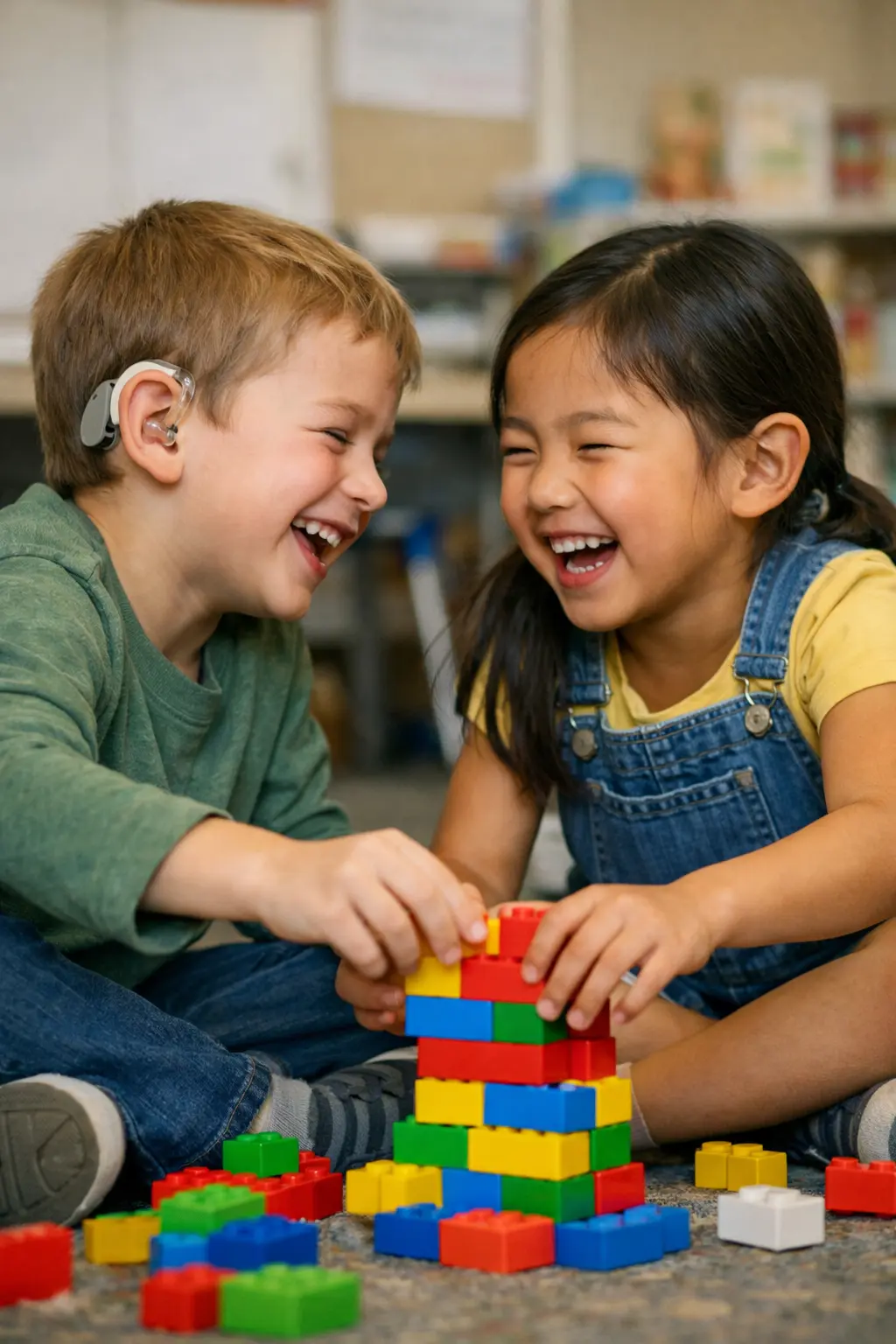
- Plan the activity: Choose something structured like building with LEGOs, baking cookies, or a specific board game. This reduces the pressure to constantly come up with conversation and gives a shared focus.
- Stay nearby but don’t hover: Be available to gently facilitate if needed, but let them lead.
Teach Advocacy and Self-Advocacy
Your child needs to feel empowered to speak up about their needs.
- Practice simple scripts: “I hear better if you face me when you talk.” “Can we move away from that loud noise so I can hear you?”
- Normalize hearing devices: If your child uses hearing aids or a cochlear implant, help them explain it to friends in a simple, positive way: “This is my super-ear. It helps me hear you better!”
Partner with the School
Social success happens in the classroom and playground too.
- Talk to the teacher: Share your concerns about social skills and ask what they observe. Collaborate on strategies.
- Request a “lunch bunch” or social skills group: Many schools offer small, facilitated lunch groups where children can practice social interaction in a supportive setting.
- Consider an IEP goal: If social challenges significantly impact your child’s school experience, advocate for a specific goal related to social skills in children with hearing loss within their IEP.
Educating Peers: Building a Foundation of Inclusion
Sometimes, the best support comes from the other children. When peers understand hearing loss, they become natural allies, not just playmates.
(H3) Simple Classroom Presentations
Work with your child and their teacher to give a brief, age-appropriate presentation to the class. Keep it positive and interactive.
- Explain the hearing devices: Show a picture or, if comfortable, the actual device. Explain what it does in simple terms.
- Teach three easy rules: “Get my attention before you talk.” “Face me when you speak.” “Be patient if I ask you to repeat something.”
- Make it fun: Let classmates try on a pair of noise-reduction headphones to simulate what it’s like to hear with a hearing loss.
Fostering Empathy Through Stories
Read books featuring characters with hearing loss. Discuss their experiences and how friends helped them feel included. This plants seeds of empathy and understanding in all children.
When to Seek Extra Support
While many children develop social skills with consistent support at home and school, some benefit from professional help.
- Speech-Language Pathologists (SLPs): Many SLPs specialize in “social communication” or “pragmatics.” They can work individually or in small groups on conversation skills, perspective-taking, and navigating social situations.
- Social Skills Groups: These groups, often led by therapists or counselors, provide a safe, structured environment for children to practice interacting with peers who may have similar challenges.
- School Counselors or Psychologists: They can offer support for anxiety or low self-esteem that may arise from social difficulties.
Frequently Asked Questions (SSS)
Q: My child seems happy playing alone. Should I still push them to socialize?
A: It’s a balance. Solitary play is healthy, but friendship skills are learned through practice. Gently encourage interaction in small, comfortable doses. If they consistently resist and seem distressed by social situations, consider seeking an evaluation from a professional to rule out social anxiety.
Q: How can I help my child when they come home upset about a peer interaction?
A: First, listen and validate their feelings: “It sounds like that was really hard. I’m sorry that happened.” Then, problem-solve together without blame. Ask, “What do you think made that conversation tricky? What could we try next time?” This turns a painful moment into a learning opportunity.
Q: What if other kids tease my child about their hearing aids?
A: This is a real fear for many parents. Prepare your child with simple, confident responses. “It helps me hear, just like glasses help people see.” Role-play these responses. Also, work with the school to address any bullying immediately and educate the class about differences.
Q: Are there specific toys or games that help build social skills?
A: Absolutely! Cooperative board games (where players work together, not against each other) are excellent. Games like “The Sneaky Snacky Squirrel” or “Outfoxed” encourage turn-taking and shared problem-solving without the pressure of direct competition.
Q: At what age should I start focusing on social skills?
A: It’s never too early! Even toddlers benefit from parallel play and gentle coaching (“Let’s ask Sarah if we can have a turn”). Formal, explicit teaching of social skills in children with hearing loss often becomes most crucial around ages 4-7, as peer interactions become more complex.
Conclusion: Your Role as the Bridge Builder
Raising a child who navigates the social world with confidence is one of the most profound gifts you can give. Nurturing strong social skills in children with hearing loss requires patience, creativity, and a willingness to be their bridge to connection. You are the one who explains the joke they missed, who practices the conversation before the playdate, and who advocates for their inclusion at school. The journey has its tough moments, but every time your child shares a laugh with a friend or stands up for themselves with a new phrase, you’ll know the effort is worth it. You are not just teaching skills; you are building the foundation for a lifetime of meaningful relationships.