instagram.com/SpecialKidsEducation
Gifted children are often misunderstood. Movies and media portray them as quirky geniuses who excel at everything effortlessly. But the reality is far more complex. Myths about gifted children can lead to unrealistic expectations, missed diagnoses, and inadequate support. This guide debunks seven of the most common myths about gifted children, replacing them with facts grounded in research. Whether you are a parent, teacher, or caregiver, understanding these truths will help you better support the gifted child in your life. Dispelling these myths about gifted children is essential to providing appropriate challenge and emotional support, as discussed in our pillar resource, Gifted and Talented Education: Nurturing Exceptional Potential.
Myth #1: Gifted Children Are Born That Way — It’s Pure Genetics
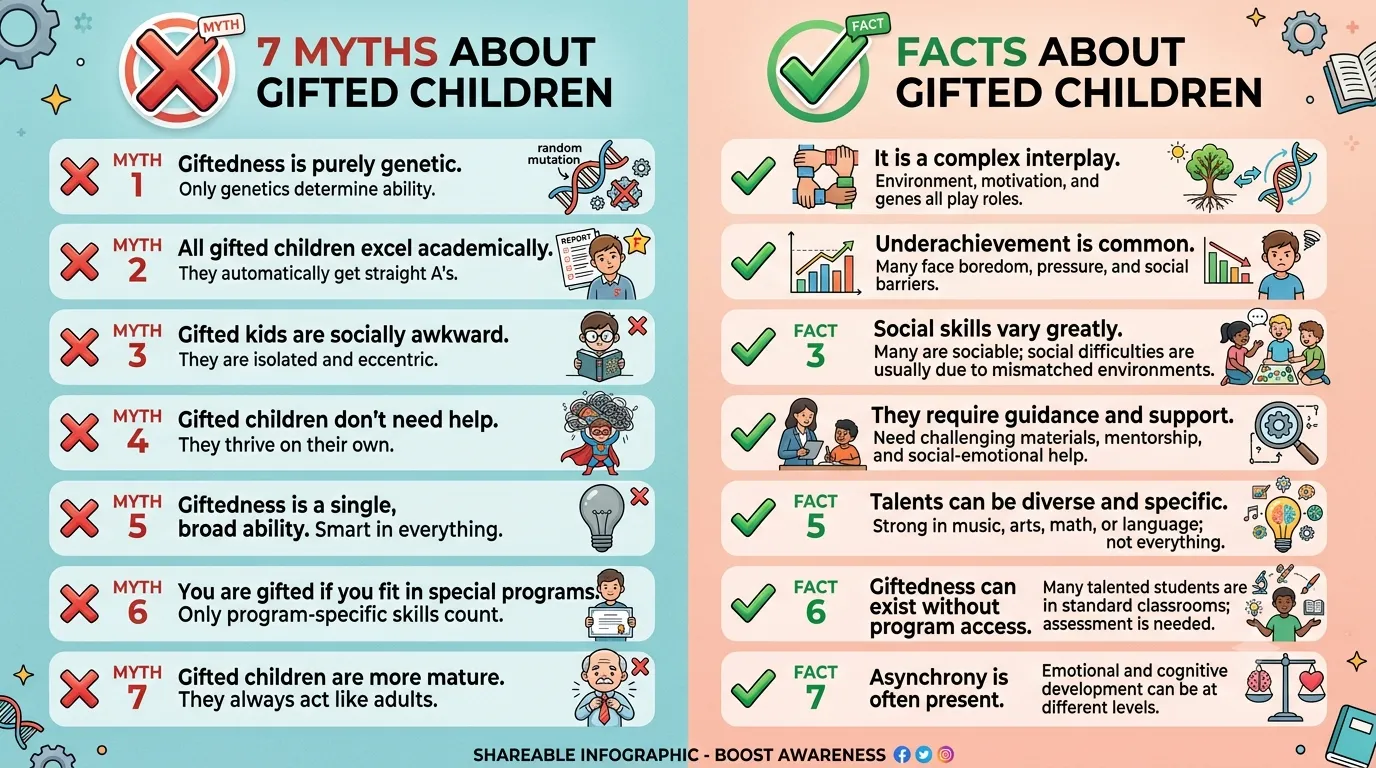
Many people believe that giftedness is simply a genetic gift, predetermined at birth. While genetics do play a significant role, the environment matters enormously. Research shows that giftedness emerges from a complex interaction between genetic predisposition and environmental factors — including stimulation, opportunities, and support. A child may have high potential, but without nurturing, that potential may never fully develop. Conversely, a child with modest potential in a rich environment can achieve remarkable things. Recognizing this truth means understanding that myths about gifted children often underestimate the importance of hard work, resilience, and opportunity.
Myth #2: Gifted Children Are Good at Everything
This is one of the most damaging myths about gifted children. Giftedness does not mean being exceptional in all areas. A child may have extraordinary verbal abilities but struggle with math. Another may have remarkable spatial reasoning but be a slow reader. Giftedness is often uneven (asynchronous). A child may think at the level of a 12-year-old but have the emotional regulation of a 7-year-old. Expecting gifted children to excel in everything sets them up for failure and perfectionism. It is more accurate to see giftedness as a specific area of high ability, not a universal superpower.
Myth #3: Gifted Children Are Always High Achievers
This myth is pervasive and harmful. It leads to the belief that if a child is underachieving, they cannot be gifted. The reality is that many gifted children struggle academically. They may underachieve because of boredom, lack of challenge, perfectionism, or undiagnosed learning disabilities (twice-exceptionality). Underachievement in gifted children is a red flag, not a contradiction. Recognizing myths about gifted children like this one helps parents and teachers look beyond grades to see the whole child.
Myth #4: Gifted Children Don’t Need Help
Because they learn quickly, many assume gifted children are “fine” on their own. This is one of the most dangerous myths about gifted children. Gifted children have unique needs — intellectual challenge, emotional support, and social connection. Without appropriate challenge, they may become bored and disengage. Without emotional support, their intensity and sensitivity can lead to anxiety and depression. Without social connection, they may feel isolated and lonely. Gifted children need help — just different help than other children.
Myth #5: Gifted Children Are Socially Awkward
Another common stereotype is that gifted children are introverted, socially awkward, or prefer solitary activities. While this is true for some, it is not a universal trait. Many gifted children are highly socially aware, empathetic, and enjoy friendships — though they may connect better with older children, adults, or other gifted peers. The social challenges they face often arise from asynchronous development (advanced intellect, younger emotional maturity) or feeling different from peers. Understanding this helps avoid the assumption that myths about gifted children define their social lives.
Myth #6: Gifted Education Is Elitist and Unnecessary
Some believe that gifted programs are elitist and that gifted children will succeed regardless. This is a harmful misconception. Gifted education is not about privilege — it is about providing appropriate challenge. Without it, gifted children can lose motivation, develop poor study habits, and underachieve. Gifted education is a form of differentiation, just like special education. It meets the needs of children who would otherwise be left unchallenged and under-stimulated. Dispelling myths about gifted children helps ensure that all children receive the education they need to flourish.
Myth #7: Gifted Children Are Emotionally Immature
While gifted children may experience asynchronous development, they are not inherently emotionally immature. In fact, many gifted children are emotionally intense, deeply empathetic, and morally sensitive. They often wrestle with abstract concerns about justice, fairness, and existential questions at young ages. Their emotional intensity can sometimes be misinterpreted as immaturity or overreaction, but it is a sign of deep processing. Recognizing this reality helps parents and teachers support their emotional needs without dismissing their depth.
Conclusion: Debunking Myths to Better Support Gifted Children
Understanding the reality behind myths about gifted children is essential for parents, teachers, and advocates. These myths can lead to unrealistic expectations, missed opportunities, and inadequate support. When we replace myths with facts, we create space for gifted children to be seen, understood, and supported as whole individuals. Giftedness is not about being perfect or easy. It is about having unique strengths and challenges that require thoughtful, individualized attention. By debunking these myths about gifted children, we take the first step toward building a world where every child — gifted or not — can reach their full potential. For more on recognizing and supporting giftedness, explore our guide on signs of a gifted child.