instagram.com/SpecialKidsEducation


When a child screams, hits, throws things, or refuses every request, the world notices. These children are labeled “difficult,” “out of control,” or “bad.” But externalizing behaviors in children are not simply defiance or poor parenting. They are outward expressions of deep distress, poor impulse control, lagging coping skills, or underlying emotional dysregulation. Unlike internalizing behaviors (withdrawal, anxiety), externalizing behaviors are disruptive and visible—and they often provoke anger, punishment, and rejection from adults. Yet punishment rarely works. Understanding externalizing behaviors in children—aggression, defiance, impulsivity—is the first step toward effective management. This guide will help you decode the meaning beneath the behavior, identify root causes, and provide evidence-based strategies for reducing outbursts and building cooperation at home and school.
What Are Externalizing Behaviors? The Outward Storm
Externalizing behaviors in children are actions directed outward toward the environment. They include aggression (hitting, biting, destroying property), defiance (refusing requests, arguing, breaking rules), and impulsivity (acting without thinking, interrupting, grabbing). These behaviors are disruptive and often trigger strong reactions from parents and teachers. But crucially, externalizing behaviors in children are not always willful. They often stem from poor impulse control, emotional dysregulation, skill deficits, or underlying conditions (ADHD, ODD, anxiety, trauma). Understanding this difference is central to our pillar resource, Emotional and Behavioral Disorders in Children: 7 Early Warning Signs Every Parent Must Know.
Recognizing externalizing behaviors in children early and intervening effectively can prevent escalation, school failure, and social rejection—and instead build self-regulation and positive relationships.
Types of Externalizing Behaviors: What to Look For
Externalizing behaviors in children fall into three main categories. Many children display a mix of all three.
Aggressive Behaviors
- Physical aggression: Hitting, kicking, biting, pushing, throwing objects at others.
- Destruction of property: Breaking toys, tearing books, damaging furniture or walls.
- Verbal aggression: Yelling, name-calling, threatening, cursing.
- Animal cruelty: Hurting or tormenting pets or animals (requires immediate professional intervention).
- Relational aggression: Spreading rumors, excluding peers, manipulating social relationships (more common in older children).
Defiant and Oppositional Behaviors
- Refusing to comply: Ignoring requests, saying “no” repeatedly, arguing about everything.
- Arguing with adults: Questioning rules, challenging authority, debating every instruction.
- Active defiance: Doing the opposite of what was asked, even when it’s against their own interest.
- Blaming others: Refusing to take responsibility, accusing others of causing their behavior.
- Being easily annoyed: Irritability, touchiness, quick to take offense.
- Spiteful or vindictive behavior: Deliberately trying to annoy or hurt others (including siblings).
Impulsive and Hyperactive Behaviors
- Acting without thinking: Grabbing items, running into the street, touching hot surfaces despite warnings.
- Interrupting and intruding: Butting into conversations, taking others’ belongings, unable to wait turn.
- Difficulty with delayed gratification: “I want it NOW” — tantrums when required to wait.
- Risk-taking: Dangerous climbing, running away, experimenting with unsafe behaviors.
- Blurting out answers: Calling out in class, interrupting, unable to hold thoughts.
Understanding the Root Causes of Externalizing Behaviors
Externalizing behaviors in children rarely happen in a vacuum. Understanding the underlying cause is essential for effective intervention.
Common Underlying Conditions
- ADHD: Impulsivity, poor frustration tolerance, hyperactivity, and difficulty with transitions often look like defiance or aggression.
- Oppositional Defiant Disorder (ODD): A persistent pattern of angry, argumentative, and vindictive behavior toward authority figures.
- Anxiety or depression: Children who are overwhelmed may lash out. Irritability is a common symptom of depression in children.
- Trauma or adverse childhood experiences: Children who have experienced abuse, neglect, or witnessed violence may use aggression as self-protection.
- Learning disabilities: Struggling academically without support can lead to frustration and acting out.
- Autism spectrum disorder: Difficulty with communication, sensory overload, and rigid thinking can trigger meltdowns that look like externalizing behaviors.
- Language delays: Children who cannot express needs verbally may use physical aggression or screaming instead.
Environmental Triggers
- Inconsistent discipline: When rules and consequences change unpredictably, children test limits more frequently.
- Chaotic home environment: High conflict, unclear expectations, or neglect can increase externalizing behaviors.
- School factors: Unchallenging or overly difficult work, negative teacher interactions, or peer rejection at school.
- Sleep deprivation: Lack of sleep dramatically increases irritability, impulsivity, and aggression.
- Hunger or poor nutrition: Low blood sugar and nutritional deficits affect mood and behavior.
Managing Externalizing Behaviors at Home: Practical Strategies
Managing externalizing behaviors in children at home requires a combination of prevention, de-escalation, and consequence—delivered consistently and calmly.
Prevention: Setting the Stage for Success
- Establish predictable routines: Consistent morning, after-school, and bedtime routines reduce anxiety and uncertainty, which can trigger outbursts.
- Preview transitions: “In 10 minutes, we’re leaving the park.” Use timers. Transitions are common flashpoints for externalizing behaviors.
- Create a calm environment: Reduce clutter, noise, and overstimulation. Make sure your child has a quiet space to retreat when overwhelmed.
- Ensure basic needs are met: Sleep, nutrition, exercise, and downtime are essential for emotional regulation.
- Catch them being good: Positive attention for desired behaviors reduces the need for negative attention-seeking.
During the Behavior: De-escalation Techniques
- Stay calm (or fake it): Your child’s nervous system mirrors yours. If you escalate, they escalate. Lower your voice, slow your movements, and keep your face neutral.
- Reduce demands: Stop giving instructions. Stop asking questions. The only goal during a meltdown is safety.
- Use minimal words: “I see you’re angry. Let’s take a break.” “First calm, then talk.”
- Offer a safe way out: “You can go to your room to cool down, or you can sit on the couch with me.” Giving a choice restores a sense of control.
- Do NOT reason, lecture, or punish during the outburst: The thinking brain is offline. No learning happens in dysregulation.
- Remove the audience: If possible, move the child to a quiet space away from siblings or peers. Externalizing behaviors are often reinforced by attention.
After the Behavior: Teaching and Consequences
- Wait until fully calm (30+ minutes): Then connect. “You were really angry. What was going on?”
- Teach replacement behaviors: “Instead of hitting, you can ask for a break. Let’s practice.”
- Use logical consequences (calmly): “You threw the toy. The toy is going away. You can try again tomorrow.” Logical consequences should be directly related to the behavior, not punitive.
- Repair: For aggression toward others, the child must make amends (apologize, draw a picture, help fix what was broken) after they are regulated.
- Never use physical punishment: Hitting a child for hitting teaches that hitting is acceptable. It also escalates aggression.
Build Long-Term Skills
- Teach emotional vocabulary: “You seem frustrated. Frustrated means you want to do something but it’s hard.”
- Practice coping skills when calm: Deep breathing, counting, asking for a break, using a calm-down kit. Practice these daily so they are available during distress.
- Use positive reinforcement systems: Token boards, point systems, or reward charts for using coping skills and managing impulses.
- Consider Parent Management Training (PMT): PMT is an evidence-based program that teaches parents to use positive reinforcement and consistent consequences effectively.
Managing Externalizing Behaviors in the Classroom
Teachers face unique challenges with externalizing behaviors in children. These strategies can help.
- Build a positive relationship: The #1 predictor of success for students with externalizing behaviors is a positive relationship with at least one adult at school. Find something to praise daily.
- Use proactive strategies: Preferential seating near the teacher, movement breaks, check-in/check-out systems, and predictable routines.
- Teach behavior expectations explicitly: “Walking in the hallway” means walking feet, quiet voice, hands to self. Model it, practice it, reinforce it.
- Ignore minor misbehaviors: Not every pencil tap or sigh needs attention. Focus attention on positive behaviors.
- Use “first/then” language: “First finish your math worksheet, then you can use the computer.”
- Offer choices: “Do you want to do the odd problems or the even problems?” Choice reduces defiance.
- Behavior-specific praise: “I like how you started your work right away.” Not “Good job.”
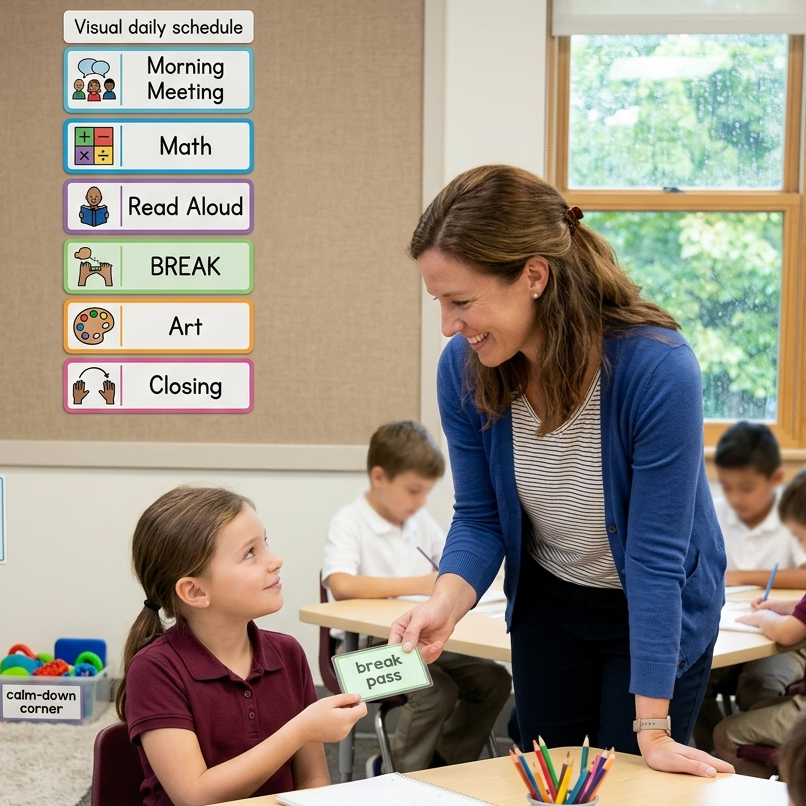
- Have a de-escalation plan: Identify a cool-down spot. Teach the student to request a break before dysregulation. Use a “break pass.”
- Conduct a Functional Behavior Assessment (FBA): For persistent, severe externalizing behaviors, an FBA identifies the “why” behind the behavior. A Behavior Intervention Plan (BIP) then teaches replacement behaviors.
When to Seek Professional Help
If externalizing behaviors in children are severe, persistent (months), dangerous (aggression causing injury), or unresponsive to consistent strategies at home and school, seek professional help.
- Start with your pediatrician: Rule out underlying medical issues (sleep disorders, seizures, lead poisoning).
- Request a school evaluation: Under IDEA, children with emotional or behavioral disorders that impact learning may qualify for special education services under “Emotional Disturbance” (ED). Put your request in writing.
- Consider a comprehensive evaluation: A child psychologist or psychiatrist can assess for ADHD, ODD, anxiety, depression, trauma, or autism.
- Parent Management Training (PMT): This evidence-based program teaches parents effective strategies for reducing externalizing behaviors and is often available through mental health clinics.
- Cognitive Behavioral Therapy (CBT): For older children, CBT can address anger, impulsivity, and problem-solving. For more on CBT, see our guide on Cognitive Behavioral Therapy (CBT) for Children with Emotional and Behavioral Disorders.
Frequently Asked Questions (SSS)
Q: Is my child manipulating me with these behaviors?
A: Most externalizing behaviors are not calculated manipulation. They are expressions of poor impulse control, skill deficits, or emotional dysregulation. A child who is regulated, skilled, and calm does not choose to hit or scream. The question isn’t “How do I punish this manipulation?” but “What skill is missing, and how do I teach it?”
Q: Should I use time-out for aggression?
A: Time-out can be effective if used correctly. It should be brief (1 minute per year of age), boring (not isolating or punitive), and followed by a brief reconnect. Time-out is not for punishing—it’s for removing reinforcement and allowing the child to calm down. However, time-out does not teach replacement behaviors. Combine it with teaching coping skills.
Q: My child is only aggressive at home, not at school. Why?
A: This is common. Children often hold it together in more structured settings and release their pent-up emotions at home where they feel safe. It doesn’t mean your child is “choosing” to be aggressive at home—it means home is where they feel safe enough to fall apart. This pattern still needs intervention; but it also suggests your child has self-control skills that can be built upon.
Q: Does my child have Oppositional Defiant Disorder (ODD) or is this typical defiance?
A: ODD is a persistent pattern (lasting at least 6 months) of angry, argumentative, and vindictive behavior that is significantly more frequent and intense than peers of the same age and developmental level. If the defiance is occasional and mild, it may be typical. If it is severe, frequent, and causes significant problems at home, school, or with peers, an evaluation for ODD is appropriate.
Q: Is medication used for externalizing behaviors?
A: Medication does not directly treat defiance or aggression. However, if underlying conditions (ADHD, anxiety, depression) are driving externalizing behaviors, treating those conditions with medication can reduce the behaviors. A child psychiatrist can assess whether medication is appropriate.
Conclusion: Behavior is Communication — Listen Beyond the Noise
Externalizing behaviors in children are loud. They demand attention. They provoke anger, exhaustion, and shame. But beneath the noise is a child who is struggling—with impulse control, with emotional regulation, with coping skills, with an undiagnosed condition, or with trauma. Your job is not to punish the noise into silence. Your job is to listen beyond it. What is the behavior saying? “I can’t control my body.” “I’m overwhelmed.” “I don’t know how to ask for help.” “I’m scared.” By decoding the message, teaching missing skills, and providing calm, consistent support, you can help your child move from externalizing to expressing—from screaming to speaking, from hitting to asking for a break. This journey is not easy. There will be hard days. But with understanding, evidence-based strategies, and professional support when needed, externalizing behaviors in children can be managed. And your child can learn to navigate their big emotions without causing harm—to others or to themselves. That is the goal: not a quiet child, but a regulated one.