instagram.com/SpecialKidsEducation

Does your child struggle to remember basic math facts? Do they mix up numbers or have trouble understanding that the numeral “5” means five objects? Do they cry or shut down when it’s time to do math homework? These difficulties could be signs of dyscalculia—a specific learning disability that affects a child’s ability to understand numbers and learn math facts. Dyscalculia in children is not about laziness or lack of effort. It’s a brain-based difference that makes processing numerical information extremely challenging. The good news is that with the right strategies—especially visual and hands-on approaches—children with dyscalculia can build math skills and confidence. This guide will help you spot the signs of dyscalculia in children, understand how it affects learning, and provide effective, visual-based teaching strategies that work at home and in the classroom.
What Is Dyscalculia? A Different Way of Understanding Numbers
Dyscalculia in children is a specific learning disability that affects a child’s ability to understand numbers, learn math facts, and perform mathematical calculations. It’s sometimes called “math dyslexia,” though it’s a distinct condition. Children with dyscalculia may have average or above-average intelligence in other areas, but their brains process numerical information differently. This makes it hard to grasp number concepts, memorize math facts, and apply math procedures. Understanding this difference is key to providing effective support. This understanding of learning differences is central to our pillar resource, Understanding Learning Disabilities in Children.
Early Signs of Dyscalculia in Children: What to Look For
Recognizing dyscalculia in children early allows for earlier intervention. Signs vary by age.
Signs in Preschool and Kindergarten
- Difficulty learning to count (skipping numbers, inconsistent order).
- Trouble recognizing that “three” means three objects (one-to-one correspondence).
- Struggles to connect a number to its quantity (the numeral “4” means four things).
- Difficulty with patterns or sorting by size, shape, or color.
- Loses track when counting objects; counts the same object twice or misses items.
Signs in Elementary School (Grades 1-4)
- Extreme difficulty memorizing basic math facts (addition, subtraction, multiplication tables).
- Uses fingers to count long after peers have stopped.
- Trouble with place value (understanding that the “3” in 32 is different from the “3” in 302).
- Difficulty with word problems; can’t figure out which operation to use.
- Reverses or transposes numbers (writes 52 instead of 25).
- Struggles with telling time, counting money, or measuring.
- Intense anxiety or avoidance around math tasks.
Signs in Older Children (Grades 5 and Up)
- Continues to struggle with basic math facts and procedures.
- Difficulty with fractions, decimals, percentages, and more abstract math concepts.
- Problems with estimation; can’t tell if an answer is reasonable.
- Trouble with math reasoning and multi-step problems.
- Poor sense of direction or difficulty reading maps.
- Struggles with time management and sequencing tasks.
How to Spot Number Processing Issues: Key Red Flags
Beyond specific academic struggles, children with dyscalculia often show core difficulties with number sense—the intuitive understanding of how numbers work. Here’s what to watch for:
- No quantity intuition: They can’t look at two small groups of objects and quickly know which has more without counting.
- Counting inefficiency: They count using their fingers or counting on long after peers have internalized these facts.
- Number reversals: Writing 12 as 21, or 73 as 37, even when copying.
- Procedural confusion: They memorize a math procedure but have no idea why it works—and forget it quickly.
- Estimation failure: If asked, “Is 48 + 27 closer to 50, 75, or 100?” they have no idea.
- Math anxiety: Avoidance, tears, or meltdowns around math tasks—often because the work feels impossible, not because they’re lazy.
Teaching Math with Visuals: Effective Strategies for Dyscalculia
Children with dyscalculia learn math best through concrete, visual, and hands-on methods. Abstract symbols and memorization don’t work well. These visual teaching strategies do.
Use Manipulatives for Every New Concept
Manipulatives are physical objects that represent mathematical ideas. They make the abstract concrete.
- Base-ten blocks: For place value, addition, subtraction, multiplication.
- Fraction tiles or circles: For understanding fractions as parts of a whole.
- Number lines: For addition, subtraction, and understanding magnitude.
- Counters (beans, coins, cubes): For one-to-one correspondence and basic operations.
- Money and clocks: Real-life math that’s tangible and meaningful.
Draw Pictures and Use Visual Representations
Before using symbols, draw the problem.
- Draw groups of objects: For addition, draw 3 apples + 2 apples = 5 apples.
- Use bar models: For word problems, draw bars to represent quantities and relationships.
- Create math diagrams: For fractions, draw circles or rectangles divided into equal parts.
- Color-code steps: For multi-step problems, use different colors for each step.
Teach for Understanding, Not Speed
Drills and timed tests are counterproductive for children with dyscalculia. They increase anxiety and don’t build understanding.
- Focus on why, not just how: “Why does borrowing work in subtraction?”
- Use estimation before calculation: “About how many should we have?”
- Teach multiple strategies: Different brains need different pathways.
- Allow unlimited time: Processing numerical information takes longer. Rushing increases errors and frustration.
Connect Math to Real Life
Abstract math makes no sense to a child with dyscalculia. Real-life math does.
- Cooking: Measuring ingredients, doubling recipes, dividing portions.
- Shopping: Comparing prices, calculating change, staying within a budget.
- Games: Board games that involve counting spaces, card games that involve matching numbers.
- Time management: “We need to leave in 20 minutes. What time will it be?”
Classroom Accommodations for Students with Dyscalculia
Accommodations remove barriers. These should be documented in a 504 Plan or IEP.
- Allow use of manipulatives and visuals: On tests and assignments, not just during instruction.
- Provide a multiplication chart or math fact reference sheet: Memorization isn’t the goal—application is.
- Allow extra time on tests and assignments: Processing numbers takes longer.
- Reduce the number of problems: Five well-understood problems are better than twenty that cause frustration.
- Provide calculators: When the goal is understanding concepts, not computation.
- Grade for process, not just answer: Award partial credit for correct steps, even if the final answer is wrong.
- Use graph paper: Helps with lining up numbers in columns.
- Provide notes or outlines: So the child isn’t trying to copy and understand simultaneously.
- Allow oral responses: Can they explain the math verbally even if they struggle to write it?
For a step-by-step guide to documenting these accommodations in a formal plan, see How to Request an IEP for a Learning Disability: A Step-by-Step Parent Guide.
At-Home Activities to Build Number Sense
These playful activities build foundational number sense without pressure.
- Board games with counting: Chutes and Ladders, Hi Ho Cherry-O (counting spaces, counting objects).
- Card games: War (comparing numbers), Go Fish (matching numbers).
- Dice games: Roll two dice and add (or subtract, or multiply).
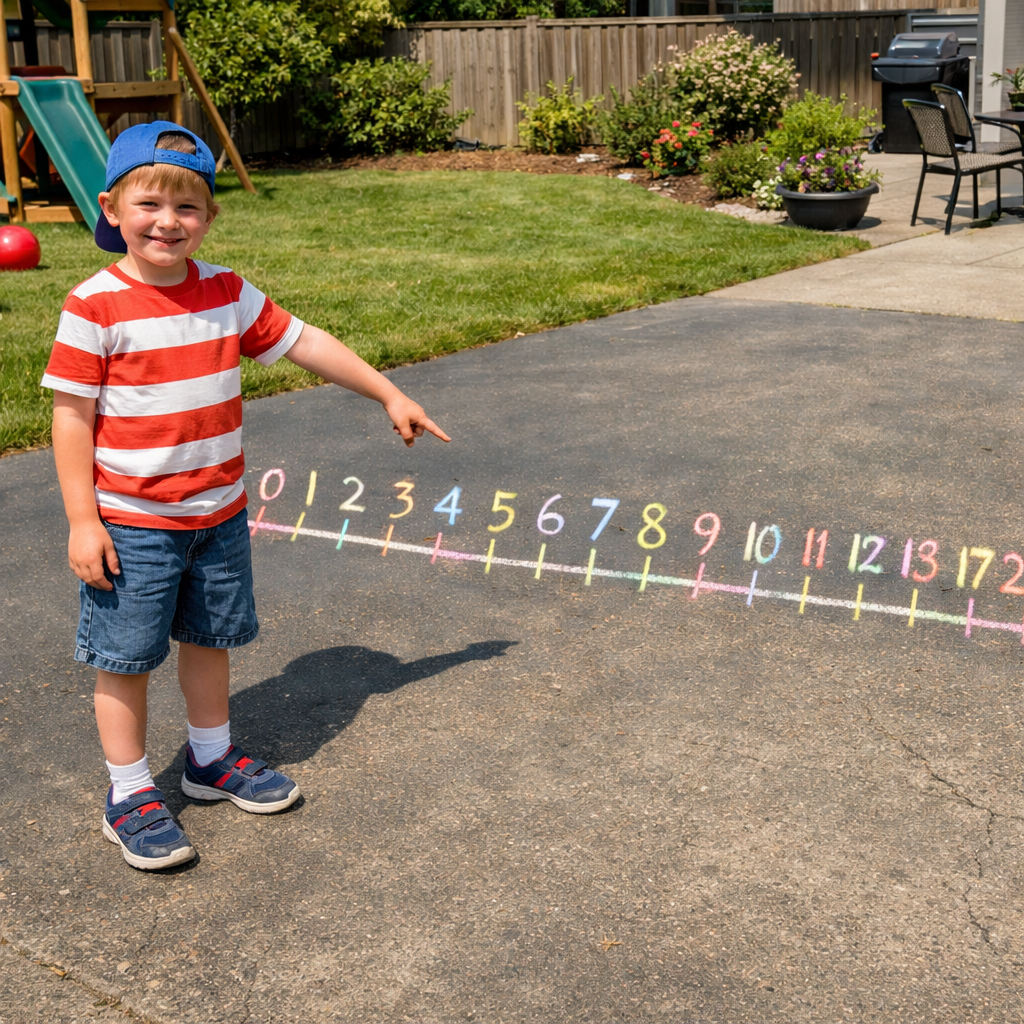
- Number line hopscotch: Draw a number line on the driveway with chalk. Hop to answer math questions.
- Cooking together: Measuring cups, doubling recipes, setting timers.
- Sorting and grouping: Laundry (match socks), silverware (group by type), coins (sort by value).
Emotional Support: Building Math Confidence
Children with dyscalculia often develop intense math anxiety. They may believe they’re “bad at math” or “dumb.” Your words and actions can change this narrative.
- Never use timed tests at home: Speed is not understanding.
- Focus on effort, not accuracy: “I saw how hard you worked on that problem. Great persistence!”
- Talk about your own math struggles: “I didn’t understand fractions at first either. It took practice and different strategies.”
- Celebrate small victories: “You remembered that 5+3=8 without using your fingers! That’s progress!”
- Separate math ability from intelligence: “Math is hard for you right now. That doesn’t mean you’re not smart. You’re smart in so many ways.”
Frequently Asked Questions (SSS)
Q: Is dyscalculia just a fear of math?
A: No. Math anxiety can develop as a result of dyscalculia, but dyscalculia itself is a brain-based learning disability. Children with dyscalculia struggle with number processing even when they’re calm and trying their hardest.
Q: Can a child with dyscalculia ever learn math?
A: Yes! With explicit, visual, multisensory instruction, children with dyscalculia can learn math. They may always struggle with memorization and speed, but they can understand concepts and apply math to real life. The goal isn’t to make them “fast”—it’s to make them functional and confident.
Q: Will my child outgrow dyscalculia?
A: Dyscalculia is a lifelong condition, but the impact can be greatly reduced with appropriate instruction, accommodations, and assistive technology. Early intervention is key.
Q: What should I do if I suspect my child has dyscalculia?
A: First, talk to your child’s teacher. Share specific observations. Then, request a formal evaluation from the school district (in writing). A comprehensive evaluation can identify dyscalculia and other co-occurring learning disabilities.
Q: Should I hire a math tutor?
A: Yes, but choose carefully. A tutor trained in multisensory, Orton-Gillingham-based math instruction (like a specially trained teacher using programs like Multisensory Math) is ideal. A traditional tutor who uses drill and repetition may increase frustration. Ask about their approach before hiring.
Conclusion: Math Is More Than Memorization
Recognizing dyscalculia in children early and providing visual, concrete instruction transforms their relationship with math. Without support, math becomes a source of anxiety and shame. With support, it becomes a subject they can approach with curiosity—or at least without fear. Your child may never love timed tests or memorizing multiplication tables. But they can learn to calculate a tip, manage a budget, measure ingredients for a recipe, and tell time. These real-world skills are what matter. And with your advocacy, the right teaching strategies, and appropriate accommodations, your child can build them. Math is more than memorization. It’s understanding. And that understanding is within reach.