instagram.com/SpecialKidsEducation

Creating an ADHD-friendly classroom is one of the most important things a teacher can do—not just for students with ADHD, but for every child in the room. When classrooms are designed with the ADHD brain in mind, all students benefit from clearer instructions, more movement, and more positive feedback. This guide offers 10 proven ADHD-friendly classroom strategies that are practical, research-backed, and designed to work in real classrooms. Whether you’re a new teacher or a seasoned educator, these ADHD-friendly classroom strategies will help you create an environment where every student can focus, learn, and thrive.
Understanding the ADHD Brain in the Classroom
Before implementing any ADHD-friendly classroom strategy, it helps to understand what’s happening inside a child with ADHD during a lesson. The ADHD brain has difficulty with executive functions—the mental skills that help us focus, organize, plan, and regulate impulses. When a student with ADHD is “off task,” it’s not defiance or laziness. It’s a brain struggling to filter distractions, hold information, or sustain attention. Punishment doesn’t fix this. Environmental support does. The ADHD-friendly classroom strategies that follow are designed to reduce barriers and create conditions where the ADHD brain can succeed. This approach to supportive education is central to our pillar resource, Understanding ADHD in Children: Signs, Challenges, and Support Strategies.
Strategy 1: Strategic Seating That Sets Students Up for Success
Where a student sits can make or break their ability to focus. In an ADHD-friendly classroom, seating is intentional.
- Front and center: Seat the student near the front to minimize visual distractions and make nonverbal cues easy.
- Away from high-traffic areas: Avoid seats near doors, windows, pencil sharpeners, or busy centers.
- Near positive peer models: Position the student near classmates who demonstrate focused behavior.
- Flexible options: Consider wiggle seats, standing desks, or quiet corners for independent work.
Strategy 2: Chunking Instruction into Manageable Pieces
Long lectures overwhelm working memory. One of the most effective ADHD-friendly classroom strategies is chunking instruction.
- Teach in 5-10 minute chunks: After each chunk, do something active or interactive.
- Give one direction at a time: Instead of multi-step instructions, break them down. Pause between each step.
- Use visual checklists: Post steps for multi-step assignments. Students check off each step as they complete it.
- Repeat and rephrase: After giving instructions, ask a student to repeat them back.
Strategy 3: Movement Breaks and Flexible Work Options
Sitting still is physically uncomfortable for many students with ADHD. An ADHD-friendly classroom builds movement into the day.
- Incorporate movement into lessons: Use kinesthetic activities. Have students stand to answer questions. Walk to different corners of the room to indicate choices.
- Schedule whole-class movement breaks: A 2-3 minute break after 15-20 minutes of focused work can reset attention.
- Allow discreet movement options: Let students stand at their desk, use a wiggle seat, or hold a fidget tool while working.
- Use a “movement pass”: For students who need more frequent movement, give them a pass to do a lap around the classroom.
Strategy 4: Clear, Consistent Routines and Visual Schedules
Predictability reduces anxiety and helps students with ADHD know what to expect. This is a cornerstone of any ADHD-friendly classroom.
- Post a daily schedule: Use pictures and words. Review it at the start of the day and before transitions.
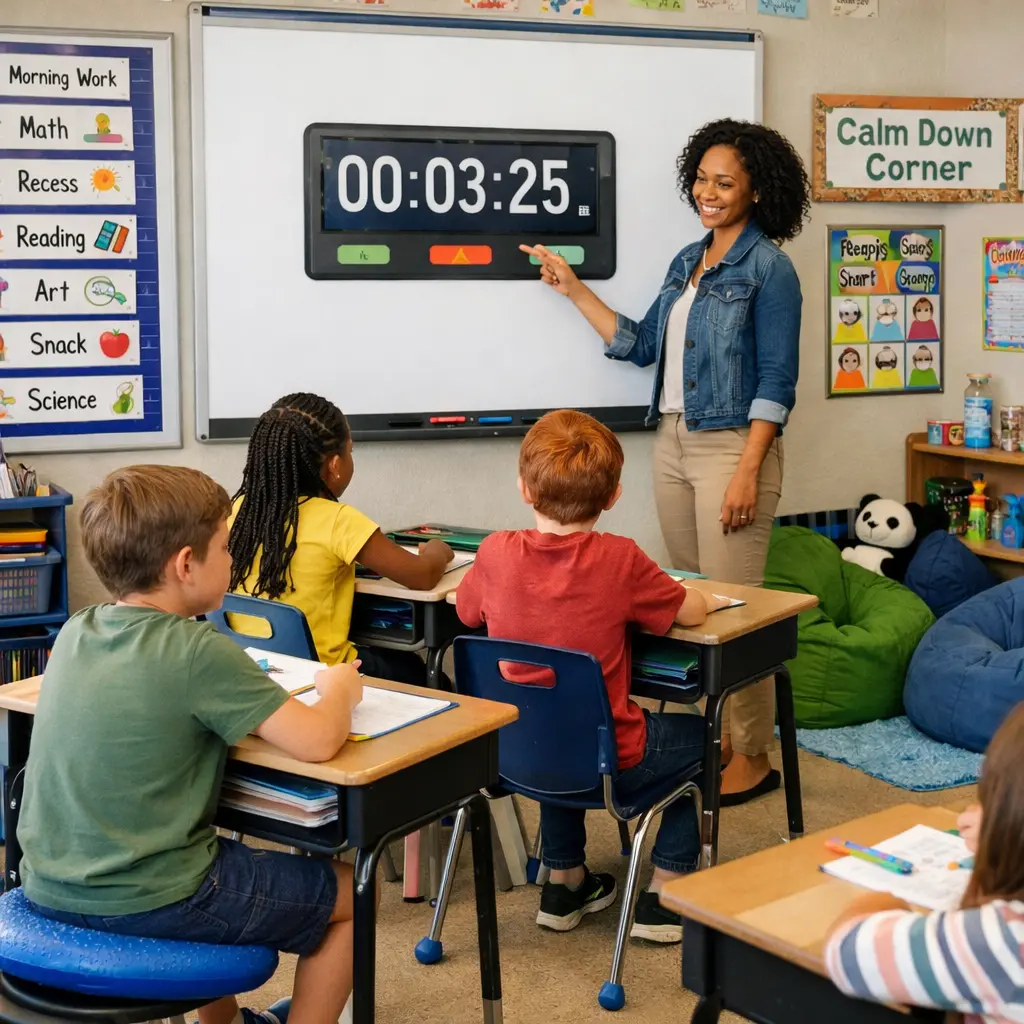
- Give transition warnings: “In five minutes, we’ll finish math and move to reading.” Use a timer visible to the student.
- Establish consistent classroom procedures: What does entering the classroom look like? How do students ask for help?
- Use a “first/then” board: “First we finish our math worksheet, then we have computer time.”
Strategy 5: Positive Reinforcement Over Punishment
Students with ADHD receive far more negative feedback than their peers. One of the most powerful ADHD-friendly classroom strategies is shifting to positive reinforcement.
- Catch them being good: Notice and name desired behaviors. “I see how focused you are right now!”
- Use a token system: Simple token boards can be powerful motivators. Make rewards immediate.
- Focus on specific behaviors: “You stayed in your seat for the whole math lesson!”
- Ignore minor misbehaviors: If a student is tapping a pencil but still working, let it go.
Strategy 6: Reducing Distractions and Overload
Classrooms are busy places. An ADHD-friendly classroom intentionally reduces sensory overload.
- Simplify the visual environment: Leave some blank wall space. Use solid colors on bulletin boards.
- Provide individual work spaces: Offer privacy folders, study carrels, or a quiet corner option.
- Manage noise levels: Provide noise-canceling headphones for students who need them.
- Reduce worksheet clutter: Cover parts of a worksheet with a blank paper to focus attention on one section at a time.
Strategy 7: Immediate, Specific Feedback
Delayed consequences are hard for the ADHD brain to connect to actions. Effective ADHD-friendly classroom strategies make feedback immediate.
- Check in frequently: Circulate and offer brief check-ins. “How’s it going? Show me what you’ve done.”
- Provide a “finished” bin: A designated place to turn in work gives a clear sense of completion.
- Use a behavior checklist: A simple chart reviewed quickly throughout the day can reinforce positive behaviors.
- Offer choices: “Do you want to do the math problems first or the reading first?”
Strategy 8: Executive Function Supports for Organization
Students with ADHD struggle with organization, time management, and planning. These ADHD-friendly classroom strategies teach these skills explicitly.
- Use color-coded folders: Assign a color for each subject to simplify material organization.
- Build in time for organization: Schedule 3-5 minutes at the end of the day to organize backpacks and folders.
- Provide a visual daily checklist: List everything needed for each part of the day. Students check off items.
- Use timers for transitions and tasks: “We have 10 minutes for independent reading. I’ll set the timer.”
Strategy 9: Strength-Based Approaches and Self-Advocacy
Students with ADHD need to hear about what they’re doing right—and learn to advocate for what they need. An ADHD-friendly classroom nurtures both.
- Identify strengths: Find ways to incorporate the student’s strengths into the school day.
- Teach self-advocacy skills: Help students learn to say “I need a break,” “Can you repeat that?” or “Can you help me?”
- Involve students in problem-solving: “You seem to be having trouble focusing during math. What do you think might help?”
- Celebrate effort, not just outcome: “I saw how hard you worked to stay focused. That took real effort.”
Strategy 10: Collaboration with Families and Support Staff
No teacher should carry this work alone. An ADHD-friendly classroom is built through partnership.
- Communicate early and often with families: Share what’s working, not just what’s challenging.
- Work with special education staff: If the student has an IEP or 504 plan, collaborate on implementation.
- Consult with school psychologists and counselors: They can offer additional strategies and support.
- Use the IEP or 504 plan effectively: Ensure accommodations are clear, specific, and being implemented.
Implementing ADHD-Friendly Classroom Strategies: A Quick Checklist
Use this checklist to assess your classroom and prioritize which ADHD-friendly classroom strategies to implement first:
- Seating: Is the student seated to minimize distractions and maximize engagement?
- Instruction: Are lessons chunked? Are instructions clear and repeated?
- Movement: Are movement breaks built into the day? Is movement allowed during work?
- Routines: Are there clear, consistent routines? Is a visual schedule posted?
- Feedback: Is positive reinforcement used more than punishment? Is feedback immediate?
- Environment: Is the classroom clutter-free? Are there options for quiet work?
- Organization: Are organizational systems in place? Is time for organization built in?
- Strengths: Are the student’s strengths being recognized and utilized?
- Collaboration: Is there regular communication with family and support staff?
Frequently Asked Questions (SSS)
Q: Won’t these ADHD-friendly classroom strategies take too much time or make me treat this student differently?
A: These ADHD-friendly classroom strategies benefit all students. Chunking instruction, using visual schedules, and incorporating movement help every learner. You’re not singling out the student—you’re creating a classroom environment where all students can succeed. And while it may feel like extra work upfront, many strategies (like establishing routines) actually save time in the long run.
Q: What if I try these ADHD-friendly classroom strategies and they don’t work?
A: Every child with ADHD is unique. What works for one may not work for another. Keep what works, modify what doesn’t, and consult with the student’s family and support team. The key is persistence and flexibility. If one approach isn’t working, try another.
Q: How do I handle disruptive behavior without punishing the student?
A: Focus on prevention first—use the ADHD-friendly classroom strategies above to reduce the likelihood of disruptive behavior. When behavior does occur, use calm, neutral responses. Redirect: “Sam, remember we’re using our quiet voices.” Use proximity: stand near the student. Use nonverbal cues: a gentle tap on the desk or a hand signal.
Q: What about the other students? Won’t they be jealous or think it’s unfair?
A: You can frame accommodations as “tools that help different people learn in different ways.” Just like some students need glasses to see the board, some need wiggle seats to focus. When other students ask, a simple “That’s what helps Sam focus” is usually sufficient.
Q: How do I balance supporting this student with meeting the needs of the whole class?
A: This is the real challenge of inclusive teaching. The answer is not to choose one over the other, but to see that a classroom structured with ADHD-friendly classroom strategies—clear routines, engaging instruction, positive reinforcement—is a classroom that supports all students.
Conclusion: Small Changes, Big Impact with ADHD-Friendly Classroom Strategies
Creating an ADHD-friendly classroom isn’t about a complete overhaul. It’s about small, intentional changes that remove barriers and create conditions for success. Strategic seating. Chunked instruction. Movement breaks. Positive reinforcement. These ADHD-friendly classroom strategies have been tested in real classrooms, and they make a real difference. For the student with ADHD, these ADHD-friendly classroom strategies send a powerful message: you belong here, you can learn here, and I am on your side. That message—of understanding, support, and partnership—is the most powerful tool any teacher has. Implement one ADHD-friendly classroom strategy this week. Then another. Watch what happens when you build a classroom where every brain can thrive.