instagram.com/SpecialKidsEducation

Does your child cover their ears at the sound of a vacuum cleaner? Refuse to wear certain clothing textures? Seek out spinning or crashing into furniture? These behaviors may be signs of sensory processing disorder in children. Sensory Processing Disorder (SPD) occurs when the brain has difficulty receiving, organizing, and responding to sensory information from the environment. For many children with sensory processing disorder in children, the world can feel overwhelming, chaotic, or even painful. This guide will help you recognize the signs of sensory processing disorder in children, identify common triggers, and create a personalized “sensory diet” to support your child’s regulation and well-being. Understanding sensory processing is an essential part of supporting children with ASD, ADHD, and other developmental differences, as discussed in our pillar resource, Understanding Autism Spectrum Disorder: Myths, Facts, and Practical Support.
What Is Sensory Processing Disorder in Children?
Sensory processing disorder in children (SPD) is a condition in which the brain has trouble receiving and responding to information that comes in through the senses. This includes the five traditional senses — sight, sound, touch, taste, and smell — as well as two additional senses: vestibular (movement and balance) and proprioception (body awareness). For a child with sensory processing disorder in children, the brain may overreact to, underreact to, or seek out sensory input in unusual ways. This can lead to behaviors that appear puzzling, disruptive, or defiant but are actually a child’s attempt to regulate their nervous system.
SPD is not a formal diagnosis in the DSM-5, but it is widely recognized by occupational therapists and is common in children with autism, ADHD, anxiety, and other developmental conditions. Understanding sensory processing disorder in children is essential for providing effective support and reducing daily stress for the whole family.
Signs of Sensory Processing Disorder in Children
Signs of sensory processing disorder in children fall into three main categories: sensory over-responsivity (hypersensitivity), sensory under-responsivity (hyposensitivity), and sensory seeking. Use this checklist to identify patterns in your child’s behavior.
Sensory Over-Responsivity (Hypersensitivity)
Children who are hypersensitive may react strongly to sensory input that others barely notice.
- Covering ears at sounds (vacuum, hand dryer, fire alarm).
- Avoiding bright or flickering lights.
- Complaining that clothing tags, seams, or certain fabrics are “itchy” or “hurt.”
- Refusing to eat foods with certain textures, temperatures, or smells.
- Being easily overwhelmed in crowded or noisy places (classroom, cafeteria, mall).
- Fearful of movement activities (swings, slides, escalators).
- Becoming distressed by unexpected touch or messy hands.
Sensory Under-Responsivity (Hyposensitivity)
Children who are hyposensitive may seem unaware of sensory input or have a high threshold for stimulation.
- Not noticing pain, temperature, or injuries.
- Seeming lethargic, unmotivated, or “checked out.”
- Unaware of personal space or body awareness (bumps into things).
- Difficulty with fine motor tasks or manipulating objects.
- Doesn’t notice when face or hands are messy.
- May not respond to their name being called or loud noises.
Sensory Seeking
Children who are sensory seekers may crave intense sensory input to feel regulated.
- Constantly seeking movement: spinning, swinging, jumping, crashing.
- Loves deep pressure: seeking tight hugs, lying under heavy blankets.
- Chewing on non-food items (shirt collar, pencils, toys).
- Excessive touching, smelling, or tasting of objects.
- Making loud noises or speaking at high volume.
- Rocking, pacing, or fidgeting constantly.
Common Sensory Triggers at Home and School
Identifying triggers is the first step to managing sensory processing disorder in children. Common triggers include:
- Auditory (Sound): Fire alarms, hand dryers, vacuum cleaners, cafeteria noise, overlapping conversations.
- Visual (Sight): Fluorescent lighting, cluttered rooms, fast-moving screens, bright colors.
- Tactile (Touch): Tags on clothing, seams in socks, certain textures (wool, velvet), sticky or wet hands.
- Olfactory/Gustatory (Smell/Taste): Strong perfumes, cleaning chemicals, school cafeteria smells, certain food textures or temperatures.
- Vestibular/Proprioceptive (Movement/Body): Fast-moving playground equipment, unexpected touch, long periods of sitting still, or needing intense movement to feel regulated.
What Is a Sensory Diet for Children with SPD?
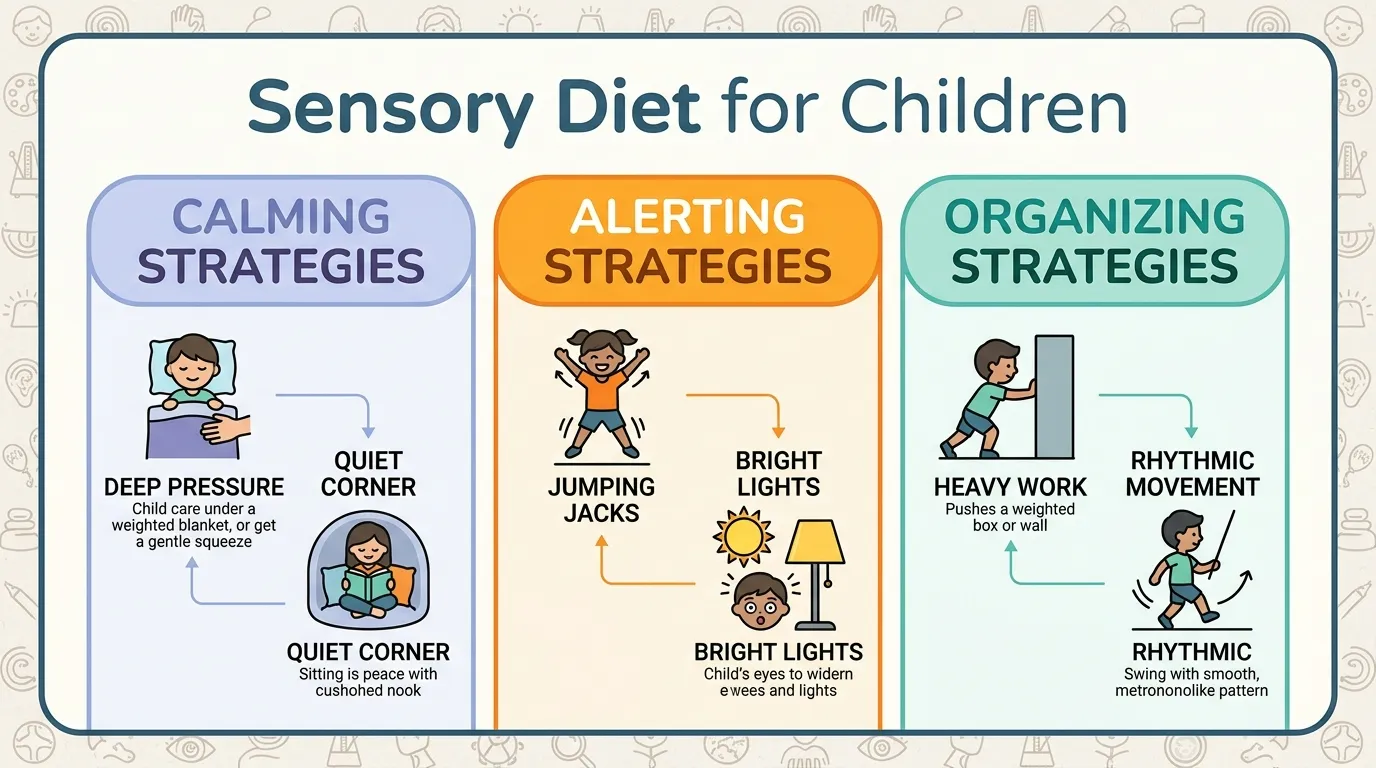
A sensory diet is a carefully designed set of activities and strategies that provide the sensory input a child needs to stay regulated, focused, and calm throughout the day. The term “diet” is used because, just like food, sensory input must be provided in the right amounts and at the right times. A sensory diet is typically developed with the help of an occupational therapist (OT) who understands sensory processing disorder in children. However, you can begin implementing simple strategies at home immediately.
Sensory Diet Strategies for Home and School
Calming Strategies (For Overwhelmed Children)
- Deep pressure: Weighted blankets, compression clothing, tight hugs, rolling up in a blanket like a “burrito.”
- Quiet space: Create a calm corner with dim lighting, soft pillows, and noise-canceling headphones.
- Slow, rhythmic movement: Rocking in a chair, gentle swinging, swaying.
- Heavy work: Pushing or pulling heavy objects (laundry basket, grocery cart), carrying books, wall push-ups.
- Oral sensory input: Chewy snacks (bagels, fruit leather), crunchy snacks (pretzels, carrots), or using a chewable sensory necklace.
Alerting Strategies (For Under-Responsive Children)
- Fast, active movement: Jumping jacks, running, spinning, trampoline.
- Bright lighting and sounds: Fun music, rhythmic clapping, upbeat songs.
- Strong tastes and smells: Mint gum, citrus scents, sour candy.
- Vibration and texture: Vibrating toys, textured surfaces (bumpy balls, different fabrics).
- Frequent movement breaks: “Can you run this errand for me?” “Let’s do 10 jumping jacks before math.”
Organizing Strategies (For Sensory Seekers)
- Heavy work: Carrying groceries, pushing furniture, wall push-ups, carrying a backpack with a few heavy books.
- Rhythmic activities: Marching, dancing, rowing, bouncing on a therapy ball.
- Deep pressure: Tight hugs, sandwiching between pillows, using a weighted blanket.
- Structured play: Building with blocks, sensory bins (rice, beans, sand), playdough.
How to Create a Sensory Diet for Your Child
- Observe your child: Keep a sensory log for 2-3 days. Note when meltdowns occur, what triggers them, and what helps your child calm down.
- Identify your child’s sensory profile: Is your child over-responsive, under-responsive, or sensory seeking? Most children are a mix of all three.
- Incorporate strategies into daily routines: Morning: deep pressure hugs, brushing teeth with vibrating toothbrush. School: movement breaks, chewing gum during tests. Evening: warm bath, weighted blanket, bedtime story.
- Consult with an occupational therapist: An OT can provide a formal evaluation and create a personalized sensory diet for your child.
Supporting Sensory Processing at School
If your child has sensory processing disorder in children, school can be overwhelming. Advocate for these accommodations:
- Preferential seating: Away from noisy areas (hallways, pencil sharpeners, windows with glare).
- Movement breaks: Allow the child to take short breaks to move, stretch, or use a fidget tool.
- Quiet space: Access to a quiet area (counselor’s office, library) when overwhelmed.
- Adaptive tools: Noise-canceling headphones, weighted lap pad, chewable pencil toppers.
- Visual schedules: Predictable routines reduce anxiety and sensory overload.
For more on advocating for accommodations, see our guide on How to Request an IEP for a Child with a Learning Disability.
Frequently Asked Questions (SSS)
Q: Can a child have sensory processing disorder without autism or ADHD?
A: Yes. SPD can occur on its own, though it is common in children with autism, ADHD, and other developmental conditions.
Q: Is sensory processing disorder a formal diagnosis?
A: SPD is not listed in the DSM-5 as a standalone diagnosis, but it is widely recognized by occupational therapists. Many children receive support under the diagnosis of “sensory integration dysfunction” or as part of their autism or ADHD diagnosis.
Q: Can sensory issues get better with age?
A: Many children develop coping strategies and improve with age. However, early intervention (occupational therapy, sensory diets) significantly improves outcomes.
Q: Can a child have both hypersensitivity and sensory seeking behaviors?
A: Yes. Many children have mixed sensory profiles. They may avoid certain sensations (loud noises) while seeking others (deep pressure, spinning).
Q: When should I seek professional help for sensory issues?
A: If sensory issues interfere with daily life — school performance, eating, dressing, sleep, or social participation — consider an evaluation by an occupational therapist.
Conclusion: Supporting Regulation Through Understanding
Recognizing sensory processing disorder in children is the first step to providing effective support. When a child’s nervous system is overwhelmed, they are not being difficult or defiant — they are struggling to cope with the world around them. By learning to identify the signs, avoid triggers, and implement a personalized sensory diet, you can help your child feel safer, calmer, and more regulated. For more information on sensory strategies for specific conditions, explore our guides on sensory overload in autism and externalizing behaviors in children.