instagram.com/SpecialKidsEducation

If your child struggles with intense anxiety, angry outbursts, persistent sadness, or other emotional and behavioral challenges, you may have heard about Cognitive Behavioral Therapy (CBT). This guide explains everything you need to know about CBT for children with emotional and behavioral disorders. We will cover what CBT is, how it works, what conditions it treats, and what you can expect from therapy. CBT for children with emotional and behavioral disorders is one of the most effective, evidence-based treatments available. It helps children understand the connection between their thoughts, feelings, and actions — and gives them practical tools to break negative cycles and build resilience.
What Is CBT for Children with Emotional and Behavioral Disorders?
CBT for children with emotional and behavioral disorders is a structured, goal-oriented form of therapy. It focuses on the relationship between thoughts, feelings, and behaviors. The core idea is simple but powerful: our thoughts influence our feelings, and our feelings influence our actions. By changing unhelpful thought patterns, children can change how they feel and behave. Unlike some therapies that explore the past, CBT is present-focused and practical. It gives children concrete skills they can use immediately. This approach aligns with the comprehensive strategies for EBD discussed in our pillar resource, Emotional and Behavioral Disorders in Children: 7 Early Warning Signs Every Parent Must Know.
How CBT Works: The Cognitive Triangle
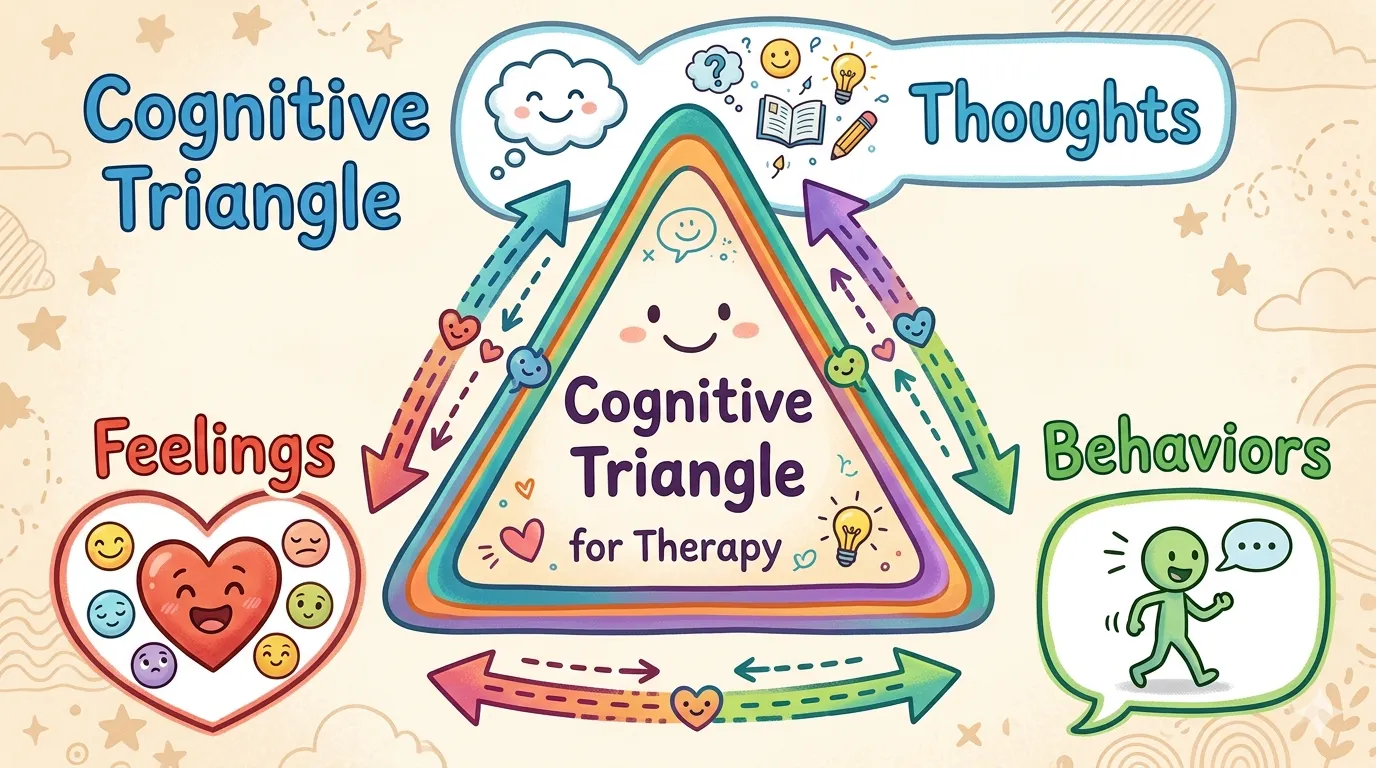
The foundation of CBT for children with emotional and behavioral disorders is something called the Cognitive Triangle.
- Thoughts: What the child tells themselves about a situation. “Everyone will laugh at me if I answer wrong.”
- Feelings: The emotional response to those thoughts. Anxiety, fear, sadness, anger.
- Behaviors: The actions that follow. Refusing to speak in class, acting out, withdrawing.
CBT teaches children to identify their automatic negative thoughts, challenge them, and replace them with more realistic, helpful thoughts. For example, changing “I’m stupid” to “This problem is hard, but I can ask for help.” Over time, this leads to better feelings and more positive behaviors.
What Conditions Does CBT Treat in Children?
CBT for children with emotional and behavioral disorders is effective for a wide range of conditions.
- Anxiety disorders: Generalized anxiety, social anxiety, separation anxiety, specific phobias, panic disorder.
- Depression: Persistent sadness, withdrawal, low self-esteem, hopelessness.
- Obsessive-Compulsive Disorder (OCD): Unwanted thoughts and repetitive behaviors.
- Trauma and PTSD: After traumatic events, CBT helps children process and cope.
- Anger and aggression: CBT teaches emotional regulation and problem-solving skills to reduce outbursts.
- ODD and conduct problems: By addressing underlying thoughts and teaching coping skills.
For more on recognizing the signs of anxiety, depression, and social withdrawal, see our guide on internalizing behaviors in children.
What to Expect in a CBT Session for Children
CBT for children with emotional and behavioral disorders looks different than CBT for adults. It is active, engaging, and often includes play, drawing, games, and practice. Here is what you can expect.
Typical Session Structure
- Check-in (5 minutes): The therapist asks how the child’s week went, what was hard, what went well.
- Review homework (5-10 minutes): Between sessions, the child practices skills. The therapist reviews that practice.
- New skill introduction (15-20 minutes): The therapist introduces a new concept or tool using age-appropriate activities — drawing, role-play, worksheets, or games.
- Practice (10 minutes): The child practices the new skill with the therapist’s guidance.
- New homework assignment (5 minutes): The therapist assigns a small practice task for the coming week.
- Parent check-in (5-10 minutes): Many CBT therapists include a brief parent check-in at the end of each session.
Examples of CBT Techniques for Children
- Feelings identification: Using a “feelings thermometer” or emotion cards to help children name and rate their emotions.
- Thought challenging: Using a “thought detective” worksheet to ask: “What’s the evidence? Is there another way to look at this?”
- Coping statements: Creating and practicing phrases like “I’ve done hard things before” or “This feeling will pass.”
- Relaxation skills: Deep breathing, progressive muscle relaxation, guided imagery, or using a calm-down kit.
- Graded exposure: Gradually facing fears in small, manageable steps (for anxiety). “First, look at a picture of a dog. Then, watch a video. Then, see a dog from across the street.”
- Problem-solving steps: Stop, think of options, pick one, try it, see what happens, try again if needed.
How Parents Can Support CBT at Home
You are not the therapist, but you are a critical partner. CBT for children with emotional and behavioral disorders works best when parents reinforce skills at home.
- Learn the language of CBT: Ask your child’s therapist for key phrases and concepts. “What’s your feeling number right now?” “Is that a helpful or unhelpful thought?”
- Practice skills in daily life: When your child is calm, practice deep breathing or coping statements. Use real-life moments as teaching opportunities.
- Model CBT for yourself: Narrate your own thought-feeling-behavior connections. “I’m feeling really frustrated because the printer isn’t working. I’m going to take three deep breaths and try again.”
- Support homework without pressure: Gently remind your child about practice tasks. Do not punish if homework isn’t done — that undermines the therapeutic alliance.
- Celebrate effort, not just success: “I saw you took a deep breath when you got upset. That was brave.”
- Stay in communication with the therapist: Brief weekly check-ins help the therapist know what is working at home and what struggles remain.
How to Find a Qualified CBT Therapist for Your Child
Not all therapists are trained in CBT. Finding the right fit is essential for success.
- Look for credentials: A licensed clinical psychologist, licensed clinical social worker (LCSW), or licensed professional counselor (LPC) with specific training in CBT for children.
- Ask the right questions: “What is your training in CBT? How much experience do you have with children my child’s age? Do you involve parents?”
- Check for evidence-based programs: Coping Cat (for anxiety), Trauma-Focused CBT (for trauma), or Incredible Years (for behavior problems).
- Start with your pediatrician or school psychologist: They may have referrals.
- Check insurance and cost: Many insurance plans cover CBT. Some clinics offer sliding scale fees.
How Long Does CBT Take to Work?
CBT for children with emotional and behavioral disorders is generally short-term. Typical treatment lasts 12-20 sessions, though some children need more or less. You may see small changes within the first few weeks (learning coping language, identifying feelings). Significant changes in behavior and emotional regulation often take 2-3 months. Consistency between sessions is key. A child who practices skills at home will progress faster than one who only practices in the therapy office.
What If CBT Doesn’t Seem to Be Working?
If you have been in CBT for 3-4 months with little or no improvement, consider these factors.
- Is there a strong therapeutic alliance? Does your child like and trust the therapist? If not, try a different therapist.
- Is your child practicing between sessions? CBT requires practice. If homework isn’t being done, ask the therapist to adjust assignments.
- Is there an underlying condition that needs additional support? Some children need medication (for severe anxiety or depression) before CBT can be effective. A psychiatrist can assess.
- Is the therapist truly trained in CBT? Not everyone who says they do CBT actually practices evidence-based CBT.
For more on managing defiance, aggression, and impulsivity at home, see our guide on externalizing behaviors in children.
Frequently Asked Questions (SSS)
Q: What age is CBT appropriate for?
A: CBT can be adapted for children as young as 3-4 years old (using play-based techniques). It is most common for school-aged children (ages 6-12) and adolescents.
Q: Can CBT be done remotely (telehealth)?
A: Yes! Many child therapists now offer CBT via telehealth. Young children may need support from a parent during the session to stay engaged.
Q: Does CBT require medication?
A: No, CBT is a standalone treatment. However, for moderate to severe anxiety or depression, CBT combined with medication (SSRIs) is often more effective than either alone.
Q: Can I do CBT with my child at home without a therapist?
A: You can use some CBT principles. However, for diagnosed disorders, working with a trained therapist is strongly recommended.
Q: Does insurance cover CBT for children?
A: Most insurance plans cover CBT as a behavioral health service. Check your plan. Some plans limit the number of sessions per year.
Conclusion: Giving Your Child Tools for a Lifetime
CBT for children with emotional and behavioral disorders is not a quick fix. It requires practice, patience, and partnership between you, your child, and the therapist. But it offers something profound: tools your child can use for a lifetime. The anxious child learns to talk back to worry. The depressed child learns to challenge hopeless thoughts. The angry child learns to pause before acting. These are not just skills for childhood — they are skills for life. If your child is struggling with emotional or behavioral challenges, CBT can help. Find a qualified therapist. Learn the language of CBT. Practice skills at home. And watch your child grow not just in managing their struggles, but in understanding themselves. That understanding is the foundation of resilience. And it is within reach.