instagram.com/SpecialKidsEducation

For a child with a learning disability, the classroom can feel like a daily battle. They watch peers read fluently while they struggle with decoding. They see others finish math worksheets quickly while they stare at a page of numbers that don’t make sense. Over time, these struggles take a toll—not just on grades, but on their sense of self. Many children with learning disabilities internalize negative messages. “I’m stupid.” “I’m bad at school.” “Everyone else is smarter than me.” These beliefs are not true, but they are powerful. The good news is that you can change them. This guide offers practical strategies for building self-esteem in children with learning disabilities, helping them see their own strengths, develop resilience, and believe in their own potential—both in and out of the classroom.
Why Self-Esteem Matters for Children with Learning Disabilities
When a child struggles academically year after year, the damage to their self-worth can be profound. Low self-esteem doesn’t stay in the classroom—it affects friendships, willingness to try new things, and even mental health. Children who feel “dumb” may stop trying, avoid challenges, or act out to distract from their struggles. But the reverse is also true. When children with learning disabilities feel capable and supported, they are more willing to persevere through difficult tasks. They develop resilience. They advocate for themselves. Understanding this emotional dimension of learning disabilities is central to our pillar resource, Understanding Learning Disabilities in Children.
Strategy 1: Separate the Disability from the Child
Children with learning disabilities often feel like they are the problem. Your first job is to help them understand the difference between “I have a learning disability” and “I am stupid.”
- Use clear, age-appropriate language: “Your brain learns reading in a different way. That doesn’t mean you’re not smart. It means we need to find the strategies that work for your brain.”
- Teach the concept of neurodiversity: All brains are different. Some brains are great at math. Some are great at art. Some are great at friendship. Your brain has strengths and challenges—just like everyone else.
- Normalize differences: “Your friend wears glasses to help her see. You use audiobooks to help you read. Different tools for different needs.”
- Never use the disability as an excuse, but always use it as an explanation: “You struggled with that test because you have dyslexia and it wasn’t formatted in a way that works for your brain. That’s not your fault. Let’s talk to your teacher about better accommodations.”
Strategy 2: Catch Them Being Good (and Be Specific)
Children with learning disabilities receive far more negative feedback than their peers. They need to hear positive messages—specific, genuine, and frequent.
- Notice effort, not just outcomes: “I saw how hard you worked on that spelling list. You kept going even when it was frustrating. That’s real persistence.”
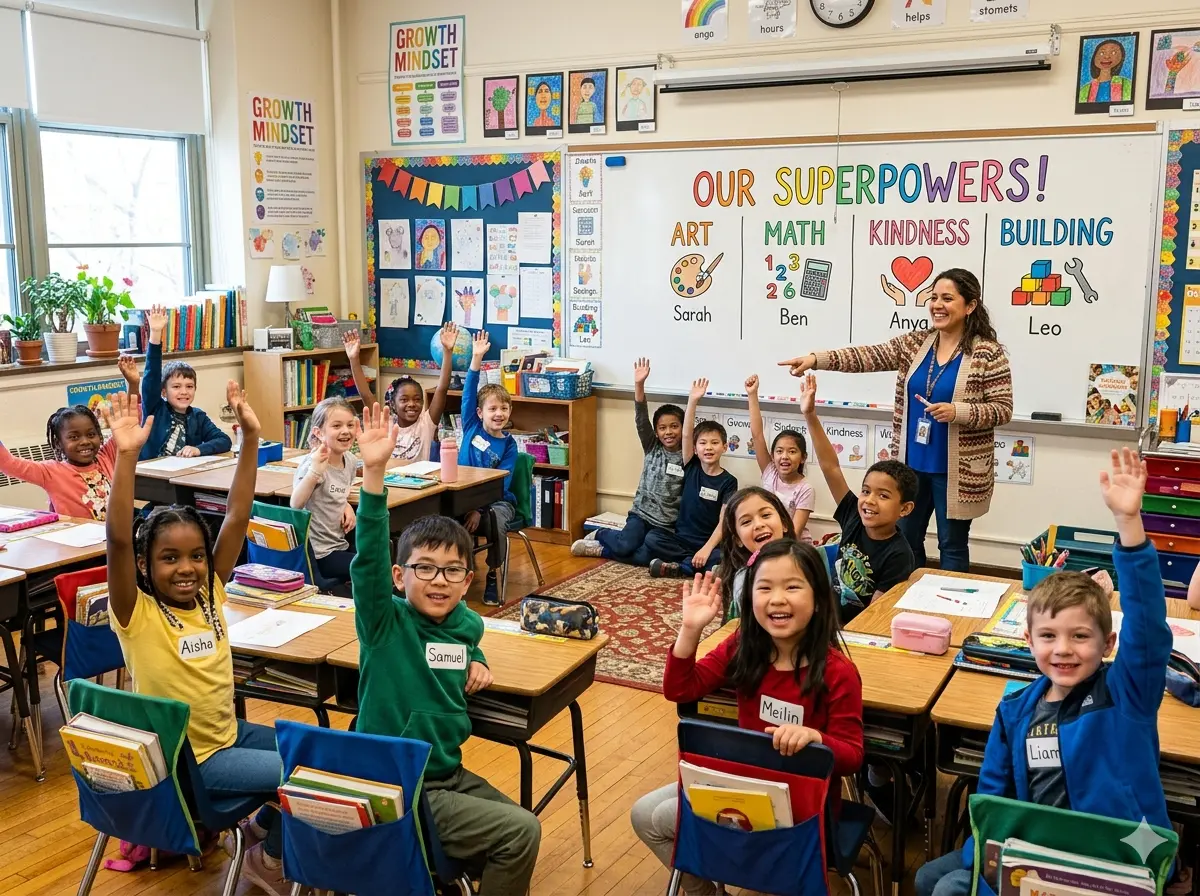
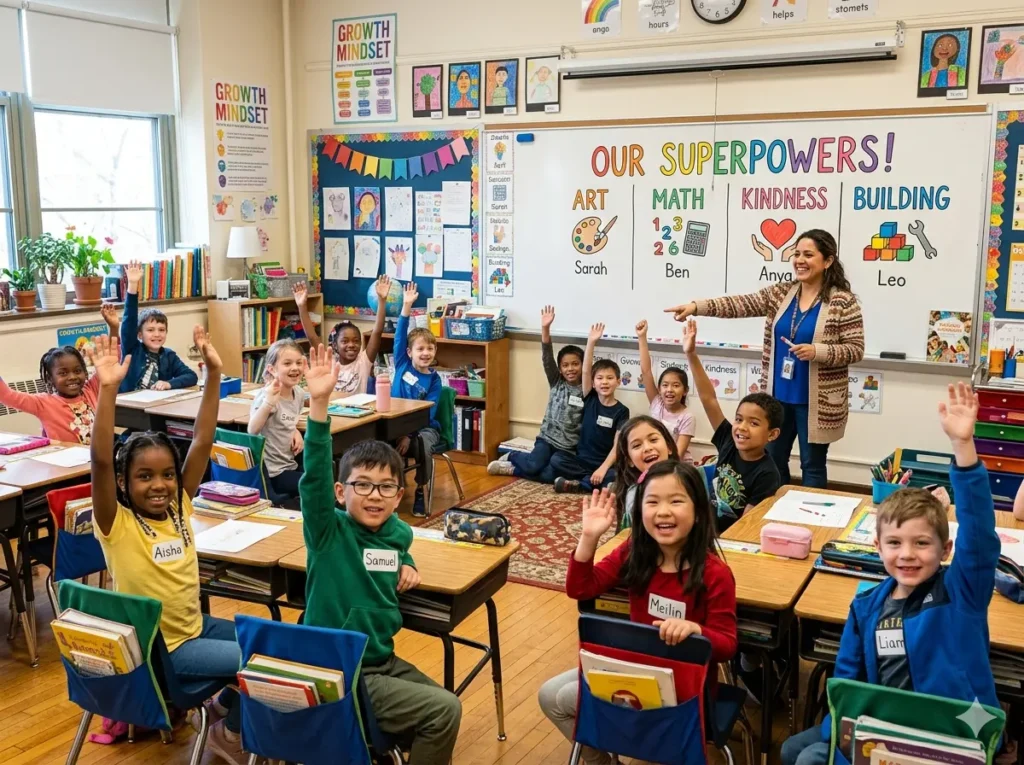
- Catch character strengths: “You were so kind to your friend when she was sad. That’s a superpower.”
- Notice non-academic wins: “You figured out how to build that LEGO set all by yourself. You’re such a good problem-solver.”
- Be specific: Instead of “good job,” say “I noticed how you checked your work carefully before turning it in. That was responsible.”
Strategy 3: Build a Strengths-Based Home Environment
School focuses on deficits—what your child can’t do yet. At home, focus on what they can do, love, and excel at.
- Celebrate non-academic strengths: Art? Sports? Music? Building? Cooking? Storytelling? Kindness? Humor? Make sure these get as much attention as reading or math.
- Create opportunities to shine: Let your child be the expert. “You know so much about dinosaurs. Teach me about that one.” “You’re so good at fixing things. Can you help me with this?”
- Display their work proudly: Art on the fridge, photos of their soccer game, a special collection they’ve organized. Their value isn’t measured by test scores.
- Share stories of successful people with learning disabilities: Albert Einstein, Whoopi Goldberg, Steven Spielberg, Anderson Cooper, Keira Knightley—all have or had learning disabilities. Their struggles didn’t stop them.
Strategy 4: Teach Self-Advocacy and Self-Knowledge
Children who understand their own learning needs are better equipped to ask for help—and less likely to feel shame about it.
- Help them name their strengths and challenges: “What’s something that comes easily to you? What’s something that’s harder?”
- Teach them to ask for accommodations: “Can you repeat that?” “I need extra time.” “Can I use my text-to-speech for this assignment?” Practice these scripts at home.
- Involve them in their own IEP meetings: Starting around age 10 or 11, children can attend part of the meeting to share their own perspective. “What’s going well at school? What’s hard? What helps you?”
- Help them explain their learning disability to peers: A simple, positive script: “My brain learns reading in a different way, so I use audiobooks. Want to listen with me?”
For a step-by-step guide to securing the accommodations your child needs, see How to Request an IEP for a Learning Disability: A Step-by-Step Parent Guide.
Strategy 5: Reframe Mistakes as Learning Opportunities
Children with learning disabilities often fear making mistakes. They’ve made so many. But mistakes are not failures—they’re data. They tell us what to try next.
- Model your own mistakes: “I burned the dinner. Oh well, let’s figure out what went wrong and try again tomorrow.”
- Use “yet” language: “You haven’t mastered that math fact yet. But you will.”
- Praise the process, not just the product: “You tried three different strategies before you found one that worked. That’s real problem-solving.”
- Celebrate brave mistakes: “You raised your hand even though you weren’t sure of the answer. That was brave.”
Strategies for Teachers: Building Confidence in the Classroom
Teachers play a critical role in building self-esteem in children with learning disabilities. These classroom strategies make a difference.
Create Opportunities for Success
- Differentiate instruction: Ensure every child can access the material at their level. Success breeds confidence.
- Offer choice: “Do you want to write a paragraph, draw a diagram, or give an oral presentation?” Choice allows students to play to their strengths.
- Provide low-stakes practice: Ungraded quizzes, partner work, and practice assignments reduce fear of failure.
- Use strength-based grouping: Let students with different strengths work together. The child with strong verbal skills can help the child who struggles with reading. Everyone contributes.
Protect Dignity
- Never call on a student to read aloud without preparation: Give them the passage in advance or ask if they’d prefer to read privately.
- Don’t draw attention to accommodations: “Everyone, please take out your audiobooks” instead of “Johnny, you can use your headphones.” Normalize different tools for different learners.
- Address teasing immediately: Create a classroom culture where differences are respected and inclusion is expected.
- Celebrate all kinds of smart: Word smart, math smart, art smart, people smart, body smart. Help each child identify their kind of smart.
Use Strengths-Based Language
- In written feedback: “You showed great creativity in your story idea. Let’s work on spelling together.”
- In parent conferences: Start with strengths. Always start with strengths.
- In classroom discussions: “What’s something you’re proud of this week?” Not just academic.
Strategies for Parents: Creating a Confidence-Building Home
Your home should be a refuge from academic pressure—a place where your child feels unconditionally valued.
- Limit homework battles: If homework is destroying your relationship, talk to the teacher about reducing the load. A child who feels supported at home is more resilient at school.
- Protect free time: Unstructured play, hobbies, and family time are not optional. They build identity outside of school.
- Build a “brag file”: Keep a folder of accomplishments—a drawing, a kind note from a friend, a certificate from a non-academic activity. Review it together when spirits are low.
- Watch your own language: “I was never good at math either” can be comforting or can lower expectations. Try “Math was hard for me too, but I learned it in my own way. You will too.”
- Connect with other families: Seeing other children with learning disabilities—who are happy, successful, and thriving—gives your child hope.
What to Do When Your Child Says “I’m Stupid”
This is one of the hardest moments in parenting a child with a learning disability. Your response matters enormously.
- Don’t just say “No, you’re not.” They won’t believe you. Instead, validate the feeling and redirect.
- Try this script: “I hear that you’re feeling frustrated. It makes sense—reading is really hard for you right now. But feeling frustrated doesn’t mean you’re stupid. It means you’re working hard at something that doesn’t come easily. Let’s take a break and then figure out what would help.”
- Point to evidence: “Remember when you figured out how to build that LEGO set without instructions? That’s not stupid. That’s smart in a different way.”
- Separate feeling from fact: “You feel stupid right now. That’s a feeling. The fact is, you have a learning disability. Those are two different things.”
Frequently Asked Questions (SSS)
Q: My child refuses to try anything hard. Is this low self-esteem?
A: Often, yes. Children who have experienced repeated failure may develop a fixed mindset: “If I try and fail, I’ll prove I’m stupid. So I won’t try.” The solution is not pressure—it’s building small successes. Break tasks into tiny steps. Celebrate effort, not just outcomes. Create so many small wins that trying feels safe again.
Q: How can I help my child when peers tease them about their learning disability?
A: First, validate their pain. “That must have really hurt. I’m sorry that happened.” Then, help them prepare a response. Simple, confident scripts work best: “My brain learns differently. That doesn’t mean I’m dumb.” Role-play. If teasing persists, advocate with the school. Your child has a right to an education free from harassment.
Q: Should I compare my child to siblings or peers?
A: Never. Comparison is the thief of joy—and of self-esteem. Your child’s only competition is themselves. “You did better on that spelling test than you did last time. That’s progress!”
Q: What if my child’s self-esteem seems fine—even too high—but they’re not working hard?
A: Some children with learning disabilities develop an overconfident exterior to mask insecurity. Or they may genuinely not understand the gap between their performance and peers. Gently provide specific, factual feedback. “You’re struggling with math facts. Let’s make a plan to work on that together.” Focus on skill-building, not shaming.
Q: When should I seek professional help for my child’s low self-esteem?
A: If your child shows signs of depression (persistent sadness, withdrawal, changes in sleep or appetite), anxiety that interferes with daily life, or talks about wanting to hurt themselves, seek professional help immediately. A therapist who understands learning disabilities can help your child develop coping strategies and a healthier self-image.
Conclusion: You Are the Voice They Will Internalize
For a child with a learning disability, the world is full of messages about what they can’t do. Tests, grades, and peer comparisons all send the same message: you’re not keeping up. But your voice—as a parent or teacher—is the most powerful voice of all. When you consistently name their strengths, celebrate their effort, and separate their worth from their struggles, they begin to internalize that message. “I am capable. I am resilient. I have strengths. I am not my learning disability.” Building self-esteem in children with learning disabilities is not about false praise or lowering expectations. It’s about seeing your child clearly—their struggles and their strengths—and helping them see themselves the same way. The journey takes time. There will be setbacks. But every time you choose connection over correction and strengths over deficits, you are building a foundation of confidence that will serve your child for life.